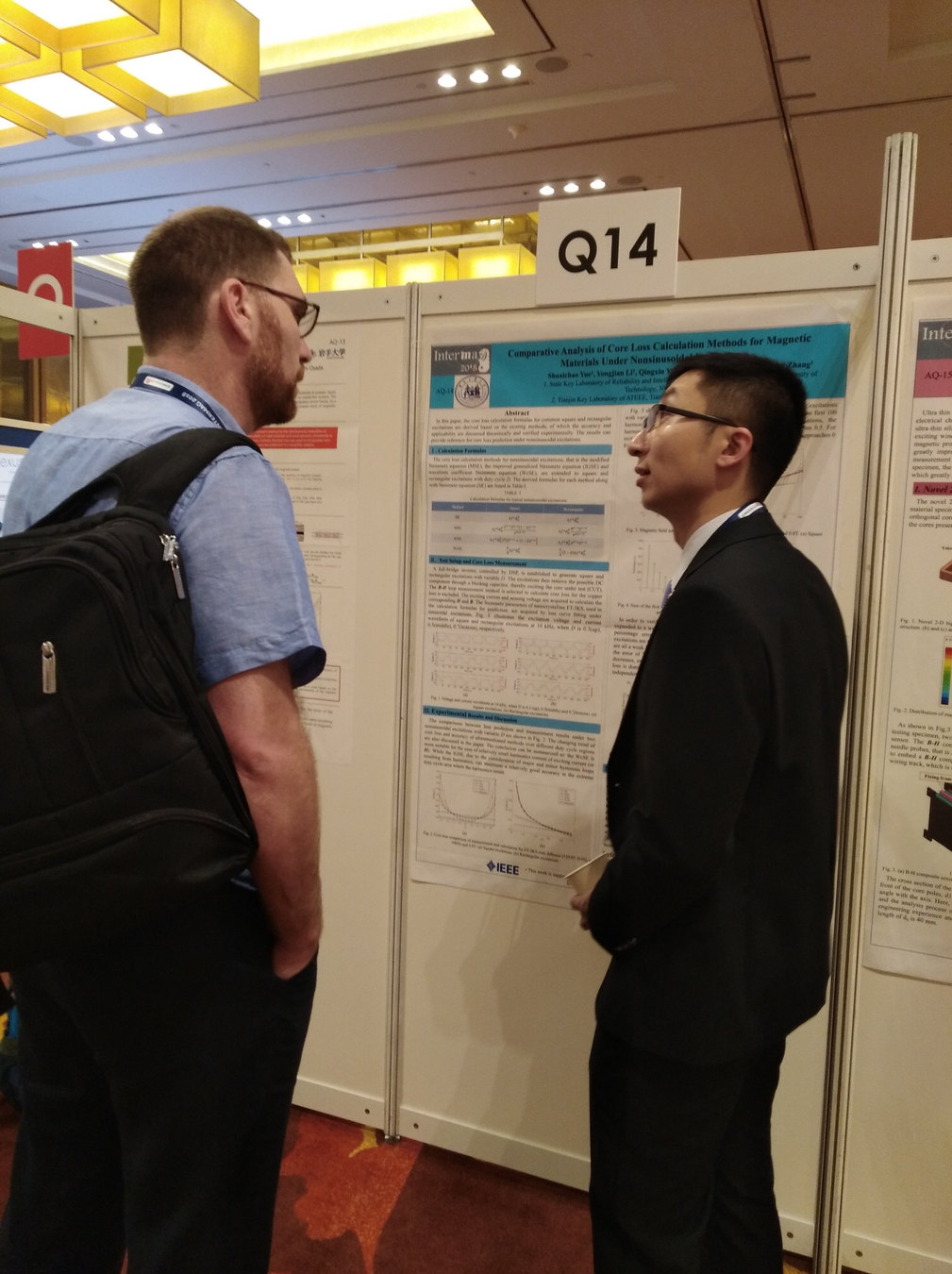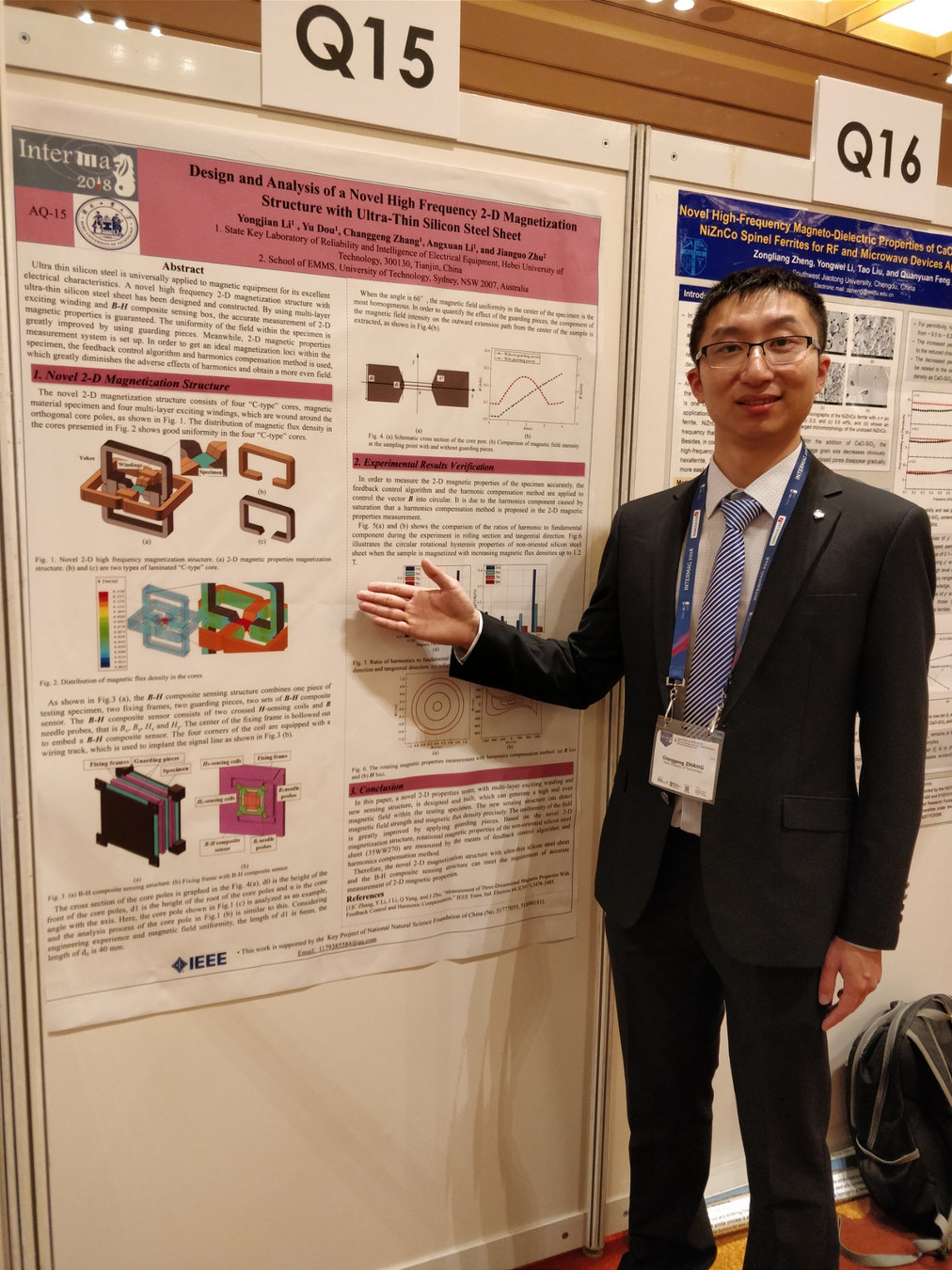
Changgeng Zhang gives an oral presentation on electrical steel under DC bias at INTERMAG 2018
-
date_range 27/04/2018 infosort Conferences labelINTERMAGelectrical steel
On 27 April 2018, Changgeng Zhang of the School of Electrical Engineering at Hebei University of Technology gave an oral presentation at the IEEE International Magnetics Conference (INTERMAG 2018) in Singapore. His talk, 3D Magnetic Properties Measurement of Silicon Steel under Biased Magnetic Excitation along Laminated Direction, was scheduled at 2:30 p.m. local time in the session on high-frequency effects in transformers and inductors (HI-03). Zhang addressed a practical question for core designers. When a magnetic field passes through a stack of steel sheets, how does it affect the loss as the steel is magnetised in the plane of the sheets? Conference programme, pp. 205–206
Measuring the effect of a field through the stack
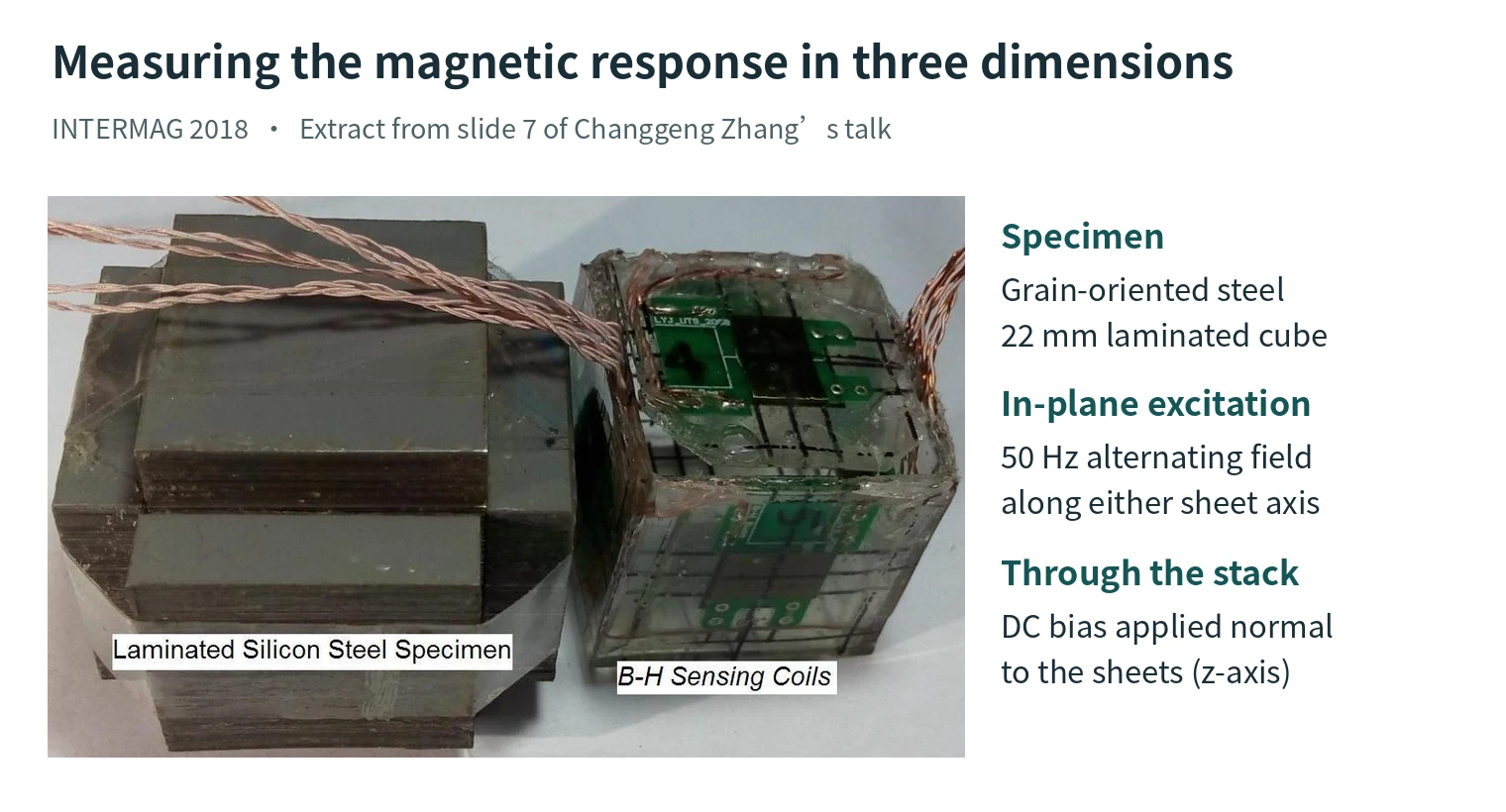
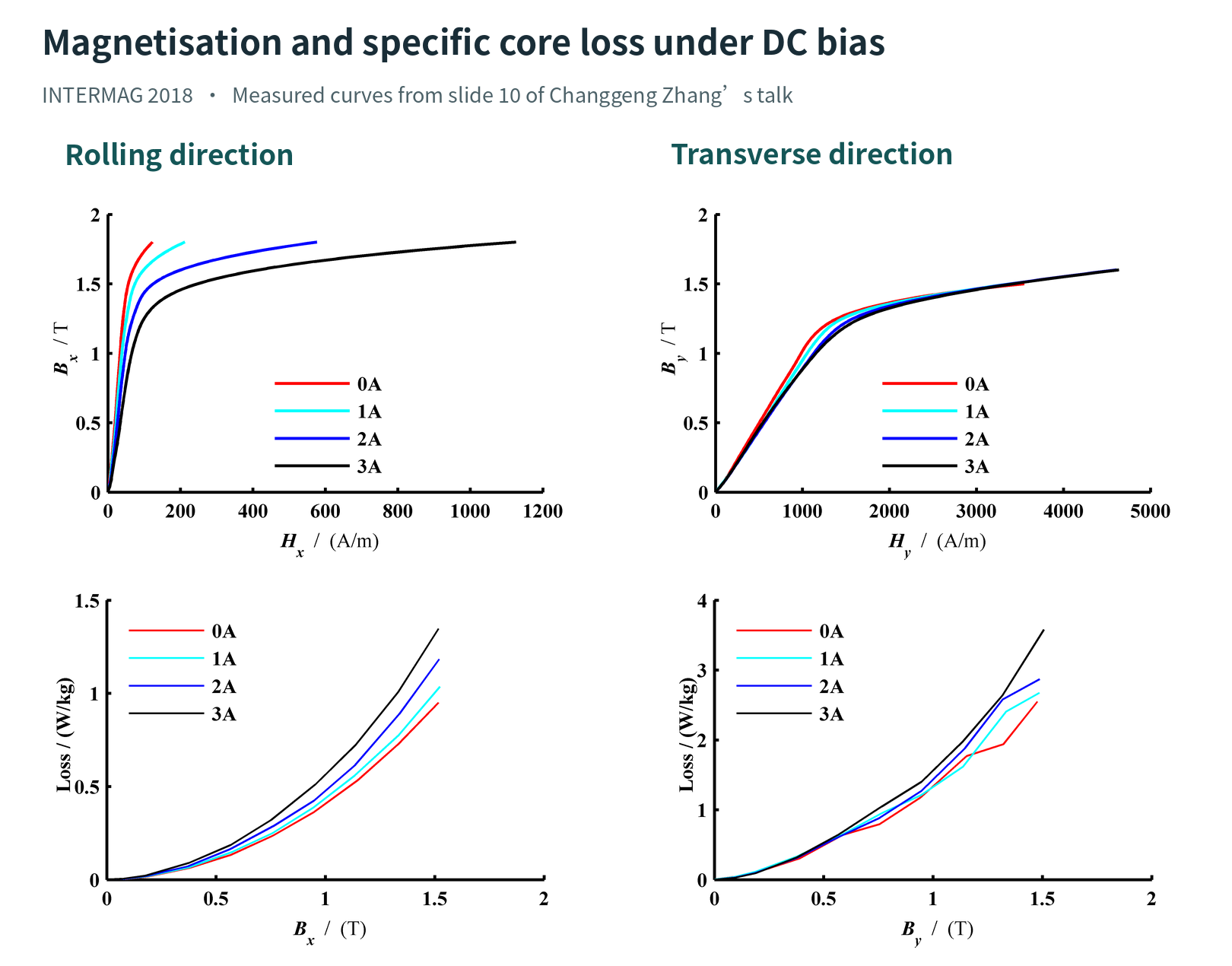
Magnetic flux changes direction at transformer core joints, and fringing flux near a reactor air gap can cross the laminations. To isolate the effect of this field component, the researchers stacked sheets of grain-oriented electrical steel into a cube 22 mm on each side. Three independent power amplifiers drove the excitation windings. With a DC field applied perpendicular to the sheets, the team applied a 50 Hz alternating field first along the rolling direction and then along the transverse direction, recording the magnetisation curves and specific core loss in each case.
In these tests, specific core loss rose in both directions as the DC bias current increased from 0 A to 3 A. The transverse measurement shows the size of the effect. Near a flux density of 1.5 T, the loss curves give approximately 2.5 W/kg without bias and 3.5 W/kg at 3 A. The measurements show why a local loss estimate near a joint or air gap needs to account for a field perpendicular to the steel, even when the alternating magnetisation is in the plane of the sheets. Zhang also compared the field-strength paths traced during clockwise and counterclockwise magnetisation and used an ellipsoidal model to describe magnetic anisotropy under bias.
About INTERMAG
Sponsored by the IEEE Magnetics Society, INTERMAG began in Washington, D.C., in 1963. It brings together researchers and engineers working on magnetic materials, magnetisation processes and devices. The 2018 meeting took place on 23–27 April at the Marina Bay Sands Expo and Convention Centre in Singapore. Its programme covered magnetic recording, spintronics, energy and power technologies, and biomagnetism. Researchers studying how magnets store information shared the programme with engineers studying where energy is lost in power equipment. Conference archive · IEEE Magnetics Society history
The conference chair reported more than 1,400 participants and approximately 1,600 presentations across 70 oral and 57 poster sessions. The programme also included nine symposia. In the poster hall, Zhang discussed methods for calculating core loss under nonsinusoidal excitation and a high-frequency two-dimensional magnetisation fixture for characterising electrical steel. IEEE Magnetics Society conference report