Changgeng Zhang and Yongjian Li present research on transformer losses and electrical steel at MMM–INTERMAG in Washington
-
date_range 18/01/2019 infosort Conferences labelMMM-INTERMAGtransformerselectrical steel
Changgeng Zhang and Yongjian Li of Hebei University of Technology presented research on transformer losses and electrical steel at the 14th Joint MMM–INTERMAG Conference in Washington, DC, on 14–18 January 2019.
About the Joint MMM–INTERMAG Conference
The Joint MMM–INTERMAG Conference is a major international meeting in magnetism. It brings together two annual conferences with long histories. The Conference on Magnetism and Magnetic Materials (MMM) spans the physics of magnetism, magnetic materials and their applications. The IEEE International Magnetics Conference (INTERMAG) has a particular strength in applied magnetics and information storage. The two first met jointly in 1976 and have generally done so every three years since. IEEE Magnetics Society history
AIP Publishing and the IEEE Magnetics Society jointly sponsored the Washington meeting in cooperation with the American Physical Society. The programme included about 1,500 talks and posters. Opening-day tutorials covered magnetometry, computational magnetism and ferromagnetic resonance. Symposia later in the week examined magnetic recording, biosensing and energy harvesting with magnetic materials. Dedicated sessions on transformers and inductors, and on magnetic instrumentation and characterisation, brought researchers who measure material behaviour into contact with engineers who use those measurements in device design. 2019 conference programme
From core loss to winding hot spots
On the morning of 17 January, Zhang presented work with Xinxiao Yan and Li in the poster session on transformers and inductors. Their poster, EN-01, showed how to account for rotational core loss in a finite-element analysis of an epoxy-cast dry-type transformer.
A related paper published after the meeting followed the heat through the foil winding of a 2,500 kVA dry-type transformer. Leakage flux induced eddy currents near the winding ends, concentrating heat there. The researchers used the calculated loss distribution to predict temperatures under natural convection and checked the predicted hot spots against infrared measurements. In the simulation, an insulating barrier between the high- and low-voltage windings redirected cooling air and reduced the average winding temperature rise by about 5 °C. Paper in IEEE Transactions on Magnetics
Measuring loss as the flux changes direction
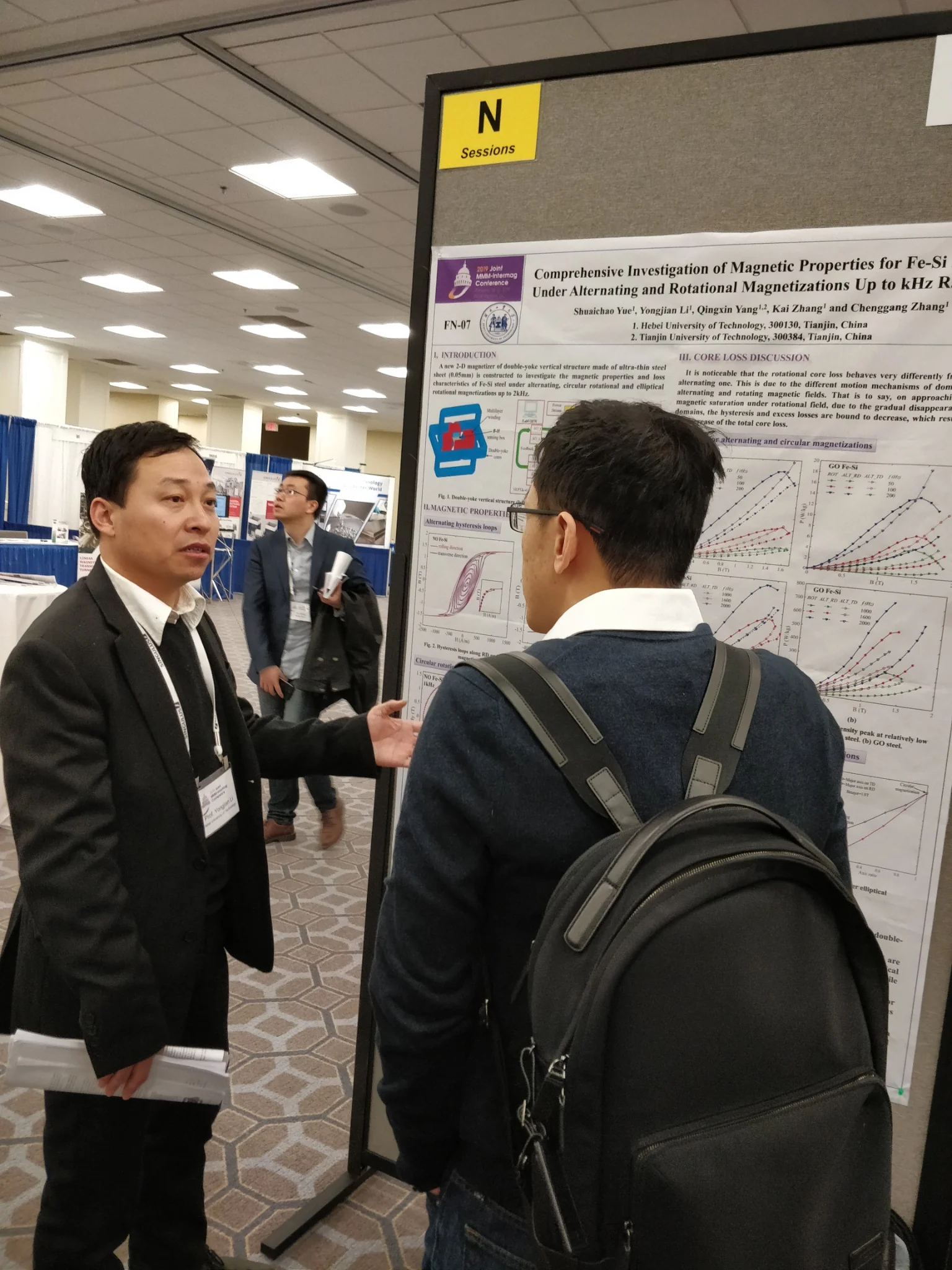
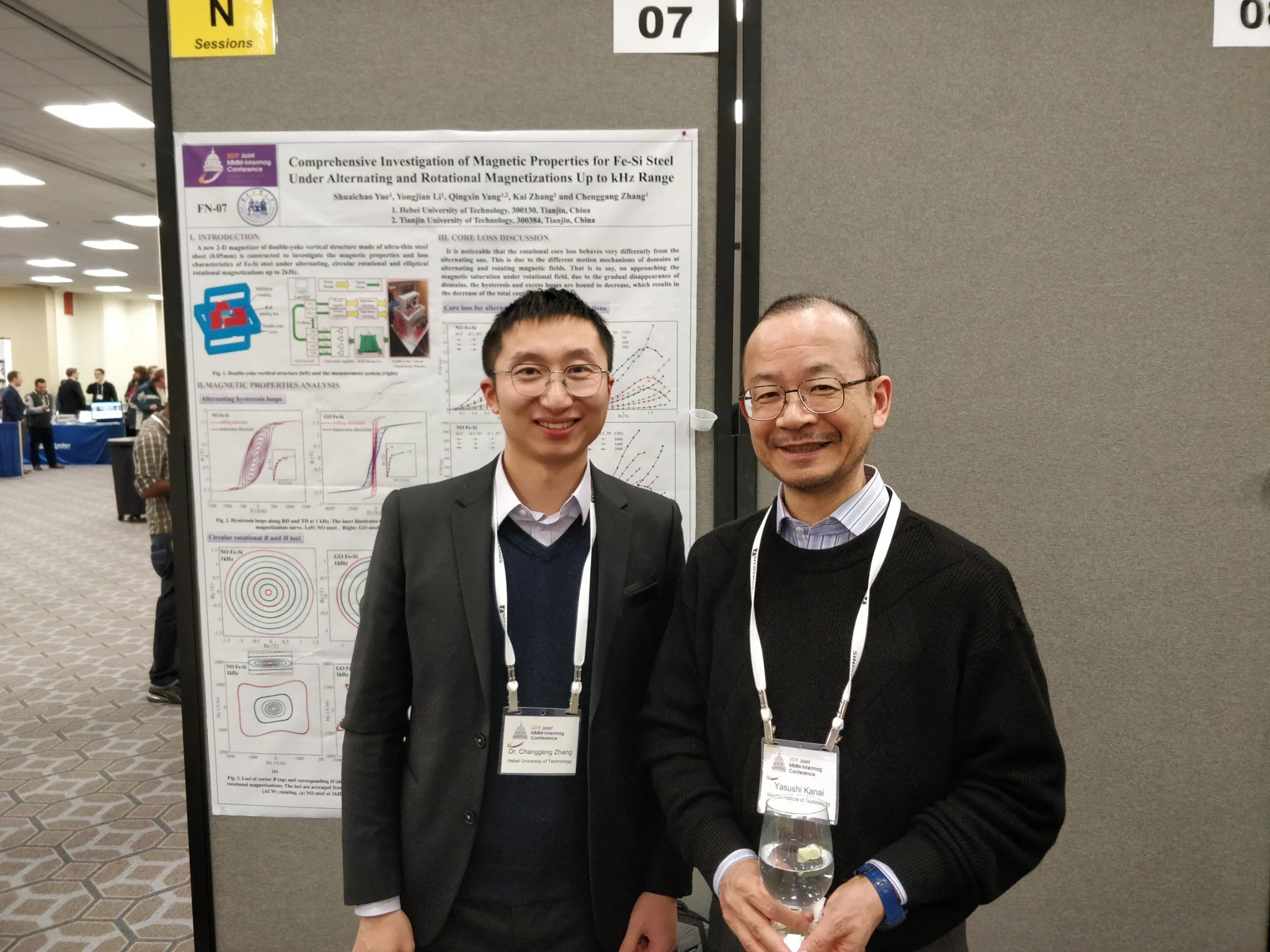
That afternoon at poster FN-07, Li discussed two-dimensional measurements on grain-oriented and non-oriented electrical steel. A double-yoke magnetiser drove the flux density back and forth along a line or around circular and elliptical paths at frequencies up to 2 kHz. Comparing the trajectories and loss curves showed how the path of magnetisation affects iron loss at a given peak flux density.
Motor vibration and sensing
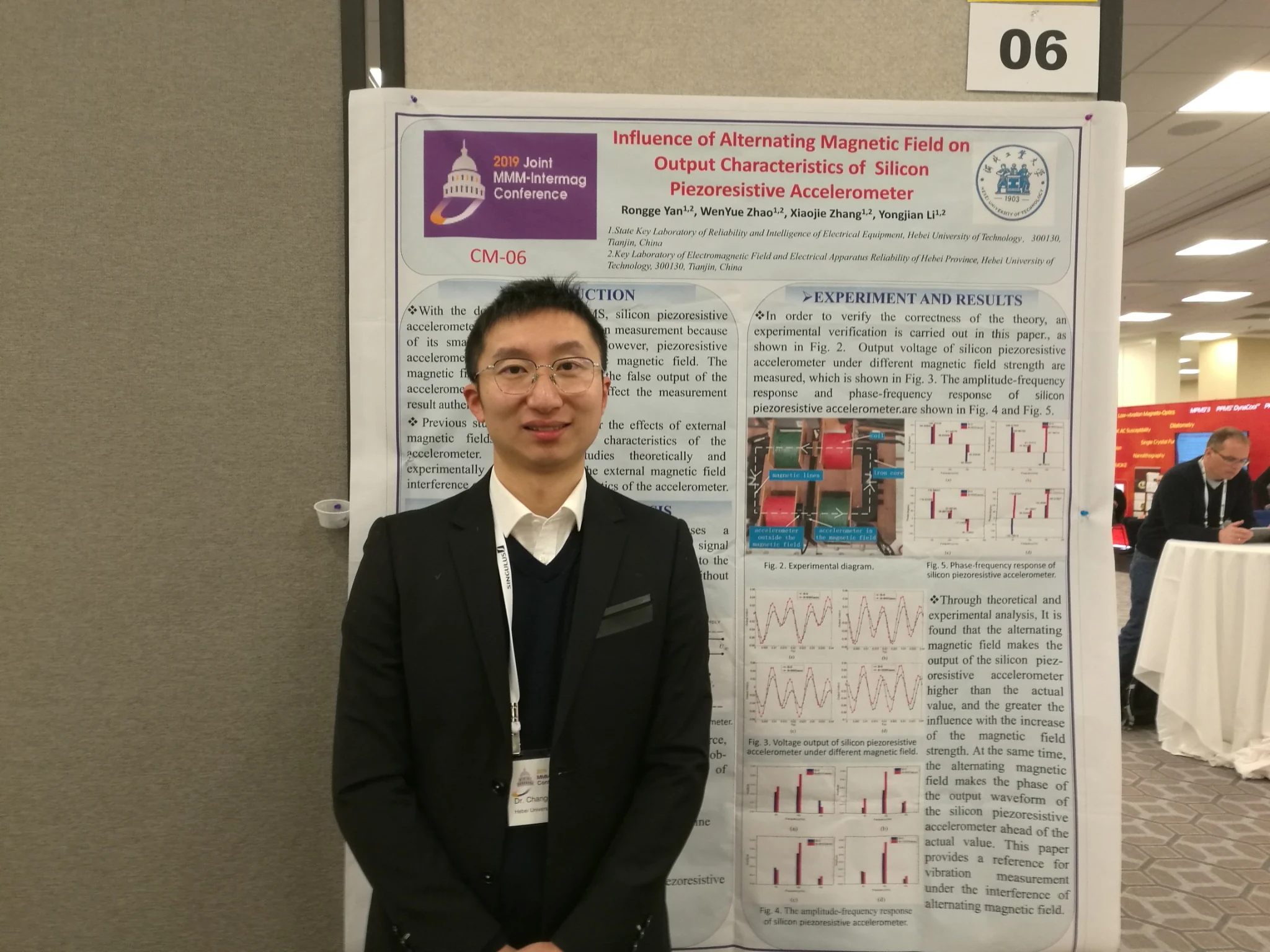
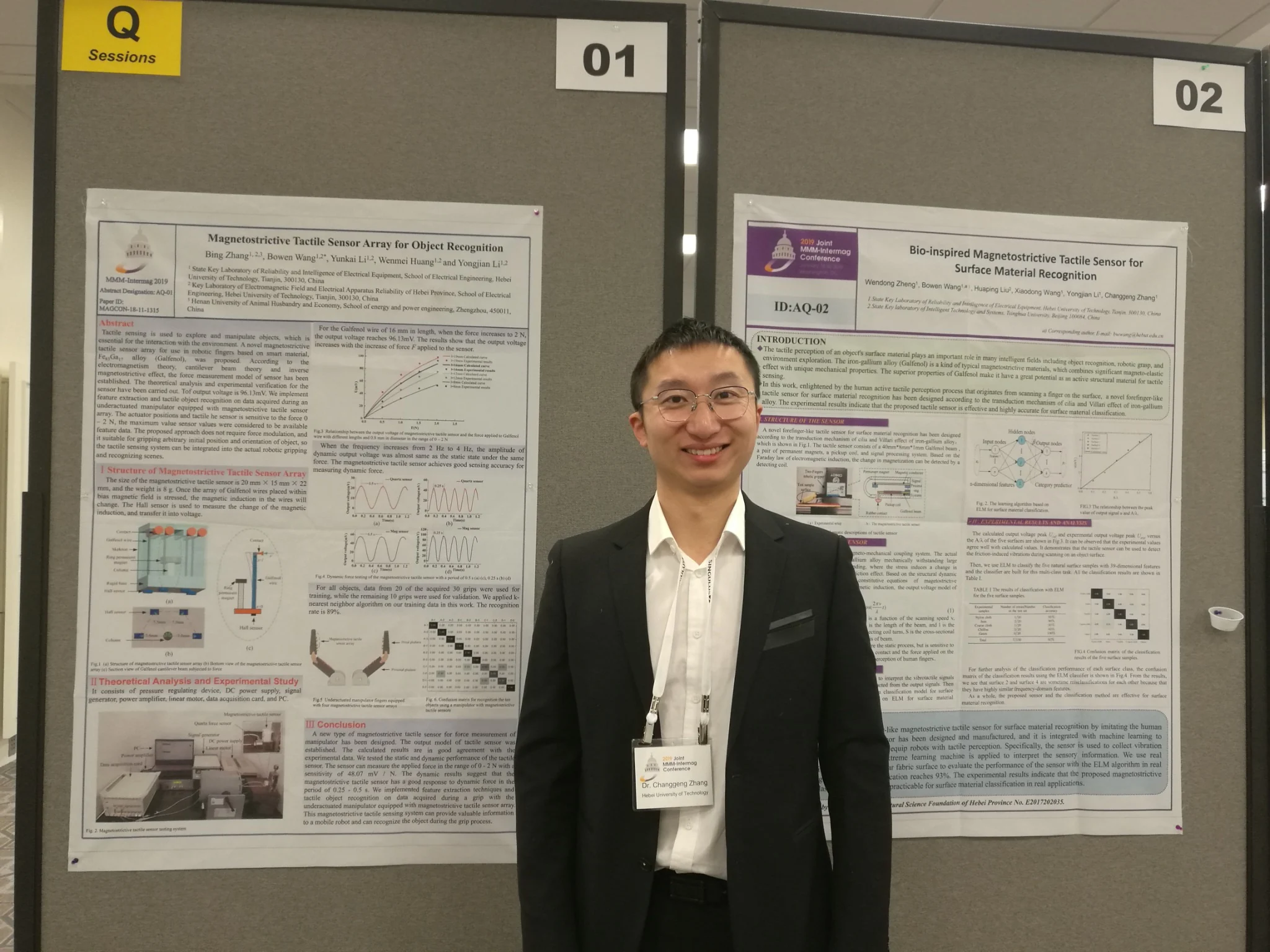
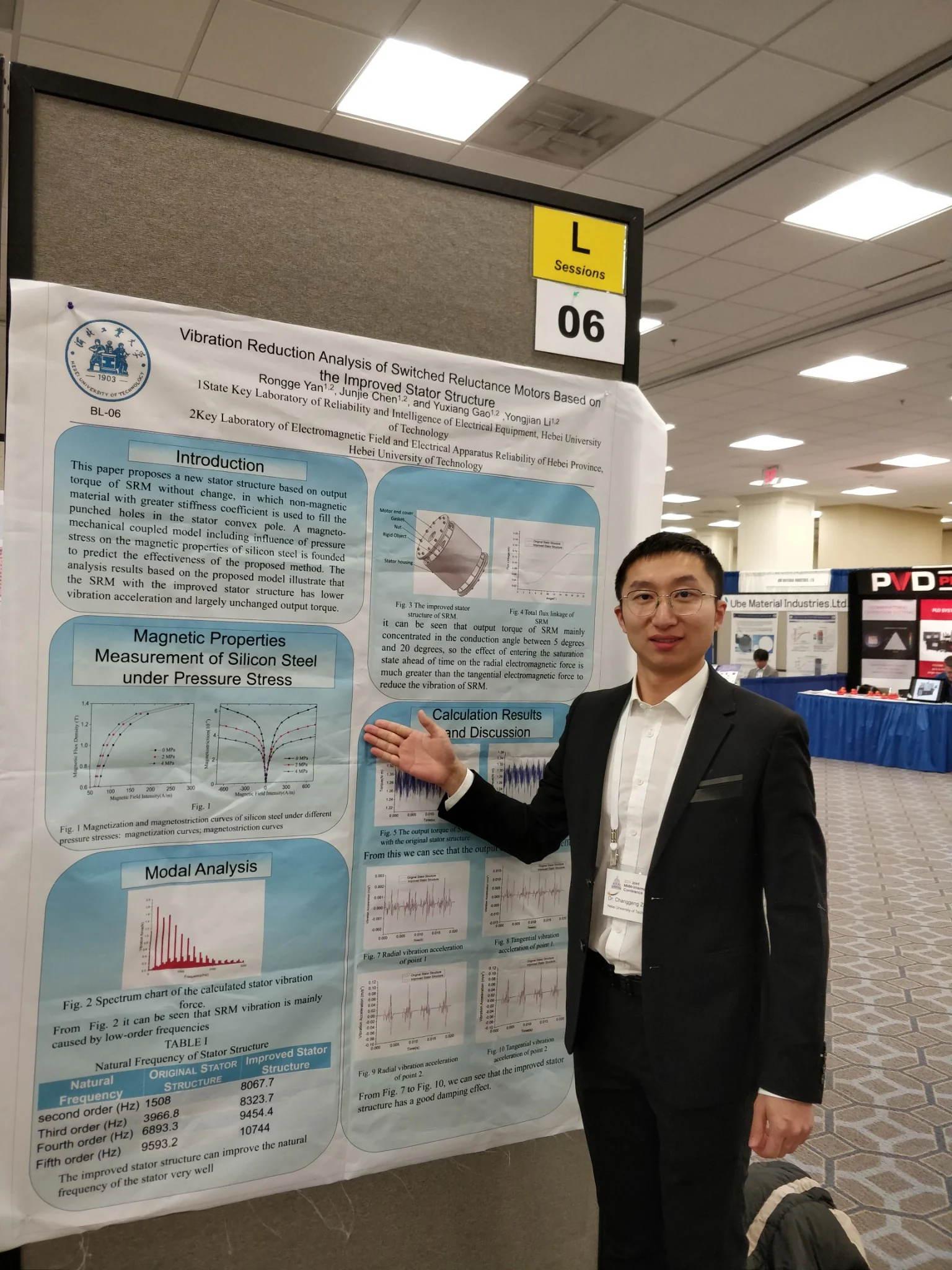
Other posters examined how to reduce vibration and how to measure it. In a model of a switched reluctance motor, non-magnetic inserts in the stator poles reduced vibration acceleration while leaving output torque largely unchanged. Separate experiments showed that an alternating magnetic field could make a silicon piezoresistive accelerometer overestimate vibration amplitude and shift the phase of its output ahead of the reference. Two tactile-sensing posters put mechanical signals to a different use. One identified objects from the forces on a robotic gripper. The other identified surface materials from vibrations as a fingertip-like sensor scanned them.