Eddy Current Loss Effect in Foil Winding of Transformer Based on Magneto-Fluid-Thermal Simulation
-
date_range 04/03/2019 00:00 infosortPaperslabelXinxiao Yan
Authors Yongjian Li, Xinxiao Yan, Chunguang Wang, Qingxin Yang, Changgeng Zhang
Journal IEEE Transactions on Magnetics 55(7), 8401705 (2019)
First published online 4 March 2019
Journal issue July 2019, volume 55, issue 7
DOI 10.1109/TMAG.2019.2897503
Download full paper (PDF) · 5 pages · 1.6 MB
Research brief
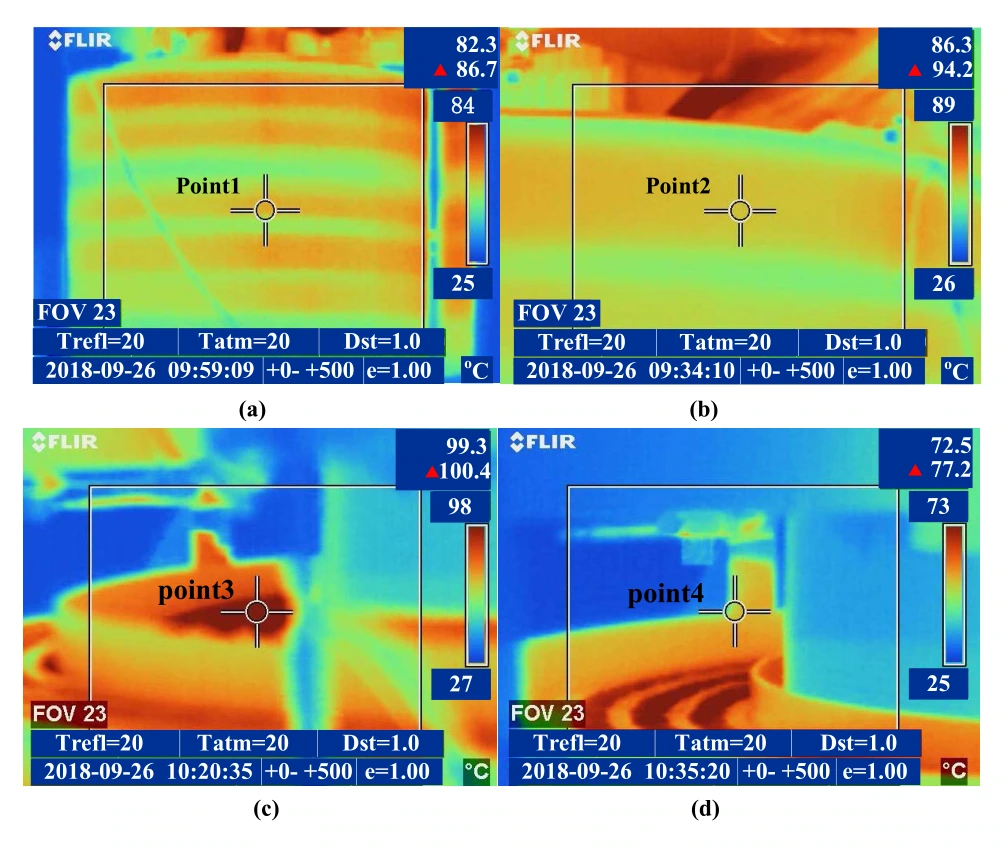
An insulation barrier changes both the flow of cooling air and radiative heat exchange between transformer windings. The team compared modeled temperatures with infrared measurements on a 2,500 kVA dry-type transformer to locate hot spots in and around its foil winding.
Abstract
The foil winding temperature distribution is crucial to the life of power transformer since local heating can accelerate aging of insulation materials. However, based on the traditional 3-D electromagnetic model and the principle of heat transfer, the non-uniform losses and temperature distribution of foil windings are difficult to estimate because of complex magnetic leakage flux. In this paper, the magneto-fluid-thermal coupling model has been established to calculate the temperature rise and predict the potential hotspots of a simplified dry-type power transformer rated at 2500 kVA. Moreover, the influence of insulation barrier is considered to reshape the air-flow path and to affect the radiative effect between the high-voltage and low-voltage windings. Experimental temperature rises are measured with infrared thermography to verify the simulation results, which achieved reasonable hotspot predictions and provide the theoretical method for transformer designers.