Thermal Network Model of High-Power Dry-Type Transformer Coupled With Electromagnetic Loss
-
date_range 11/08/2021 00:00 infosortPaperslabelYifan ChenXinghan Li
Authors Yifan Chen, Qingxin Yang, Changgeng Zhang, Yongjian Li, Xinghan Li
Journal IEEE Transactions on Magnetics 58(11), 8402105 (2022)
First published online 11 August 2021
Journal issue November 2022, volume 58, issue 11
DOI 10.1109/TMAG.2021.3104090
Download full paper (PDF) · 5 pages · 4.0 MB
Research brief
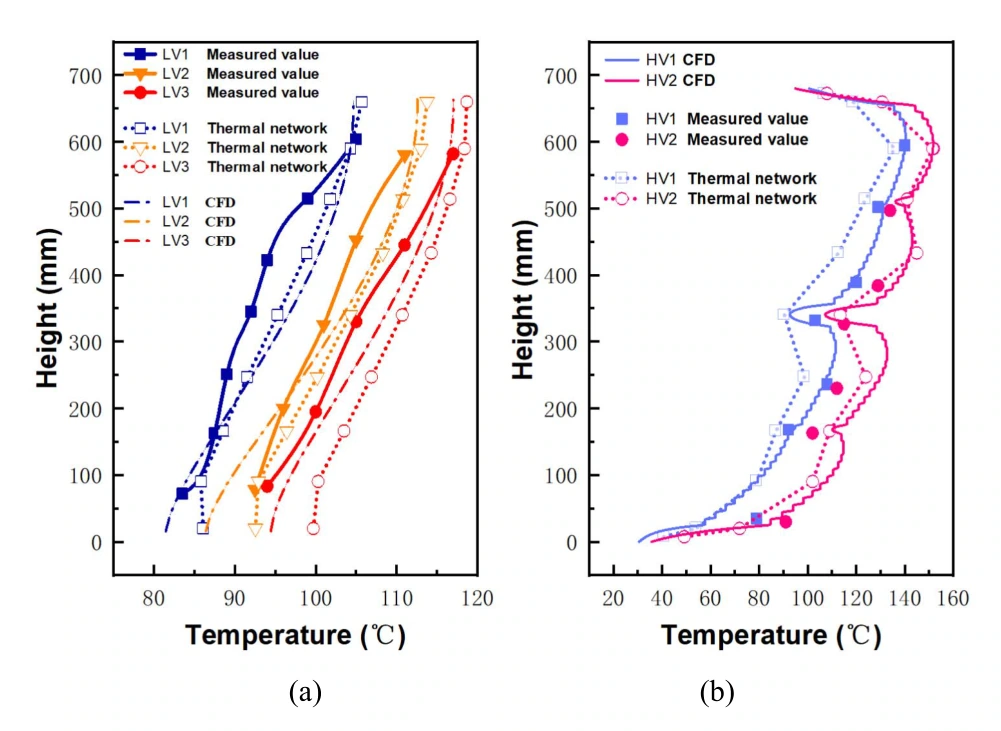
A thermal network divided the windings of a 2,500 kVA dry-type transformer into 11 regions and accounted for differences in electromagnetic loss and cooling along the ducts. The temperature-rise study located the hot spot at the top of the outermost high-voltage winding, at 151.8 °C.
Abstract
Based on thermoelectric analogy method, a thermal network model coupled with electromagnetic loss is presented. According to the actual structure of dry-type transformer windings, an accurate thermal network is established. Considering the distribution characteristics of heat source along the cooling ducts inside the dry-type transformer, the thermal parameters such as heat flux and convective heat transfer coefficients are calculated by finite element method (FEM) analysis and computational fluid dynamics (CFD). Based on the temperature rise experiment, the hottest spot located at the top of the outmost high-voltage (HV) winding is 151.8 °C, which verified the correctness of thermal network model.
Keywords Computational fluid dynamics, convective heat transfer coefficient, dry-type transformer, finite element method, thermal network method