Changgeng Zhang’s students Yakun Tian and Lan Yang defend their master’s theses in electrical engineering
-
date_range 19/05/2022 infosort Graduations labeldefence
On 19 May 2022, Yakun Tian and Lan Yang defended their master’s theses in electrical engineering at Hebei University of Technology. The School of Electrical Engineering held the session online via Tencent Meeting. Associate Professor Changgeng Zhang supervised both students. Tian examined stray losses in converter transformer shields under harmonic excitation and DC bias. Yang studied how punching motor-core laminations changes the magnetic properties of the steel near the cut.

Yakun Tian tests stray-loss predictions in transformer shields
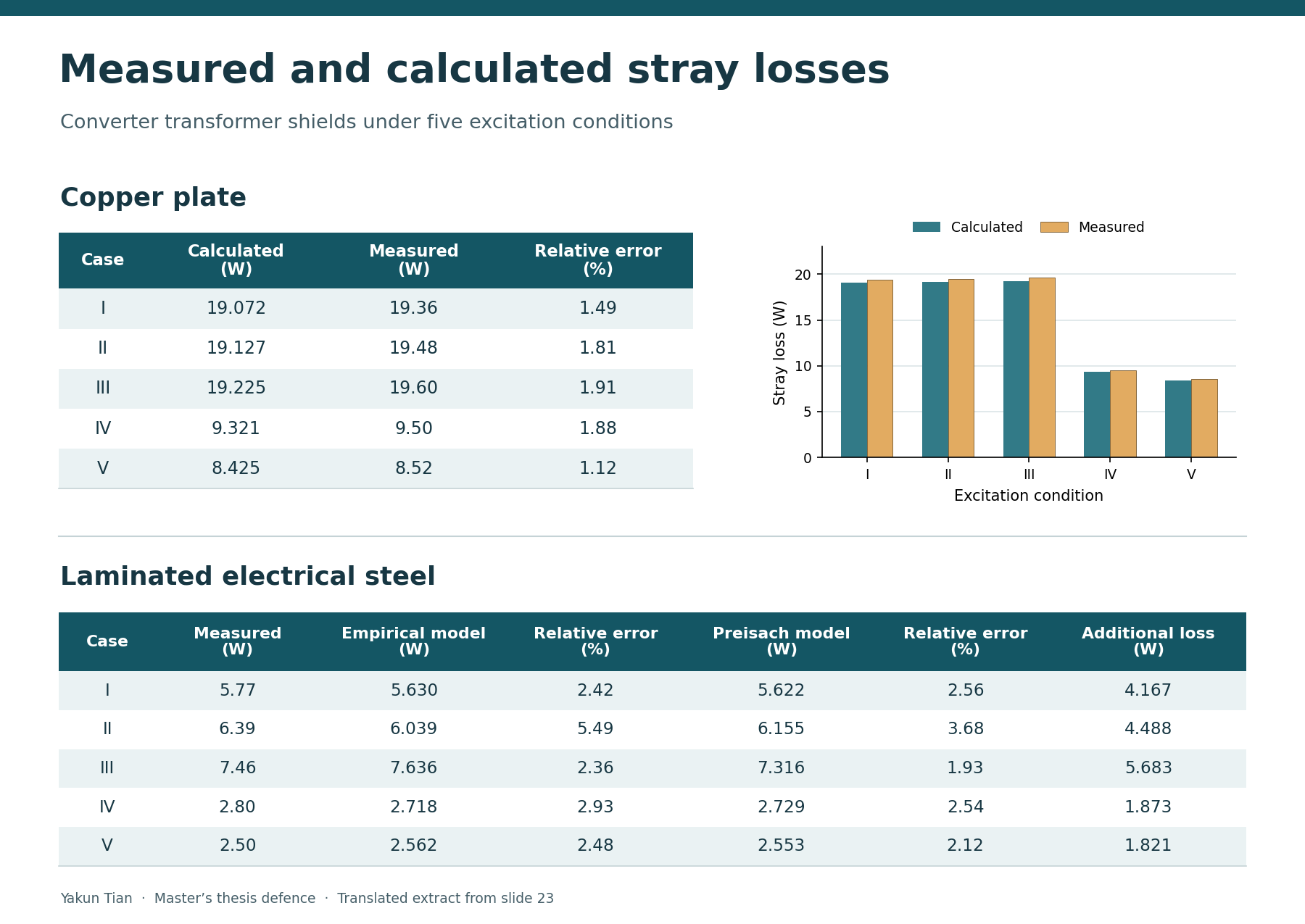
Tian added compensation coils to a TEAM Problem 21 test rig to measure the power dissipated in a shield under different excitation currents. Comparing power measurements with and without a shield in place allowed him to isolate the loss in the shield itself. He tested a copper plate and a laminated electrical steel shield under five excitation conditions.
When the excitation current included the third, fifth and seventh harmonics alongside the fundamental, the laminated shield dissipated 7.46 W. A finite-element calculation using his modified Preisach hysteresis model gave 7.316 W, a relative error of 1.93%. Read the related paper on stray loss in laminated transformer shields.
Lan Yang measures the reach of punching damage in electrical steel
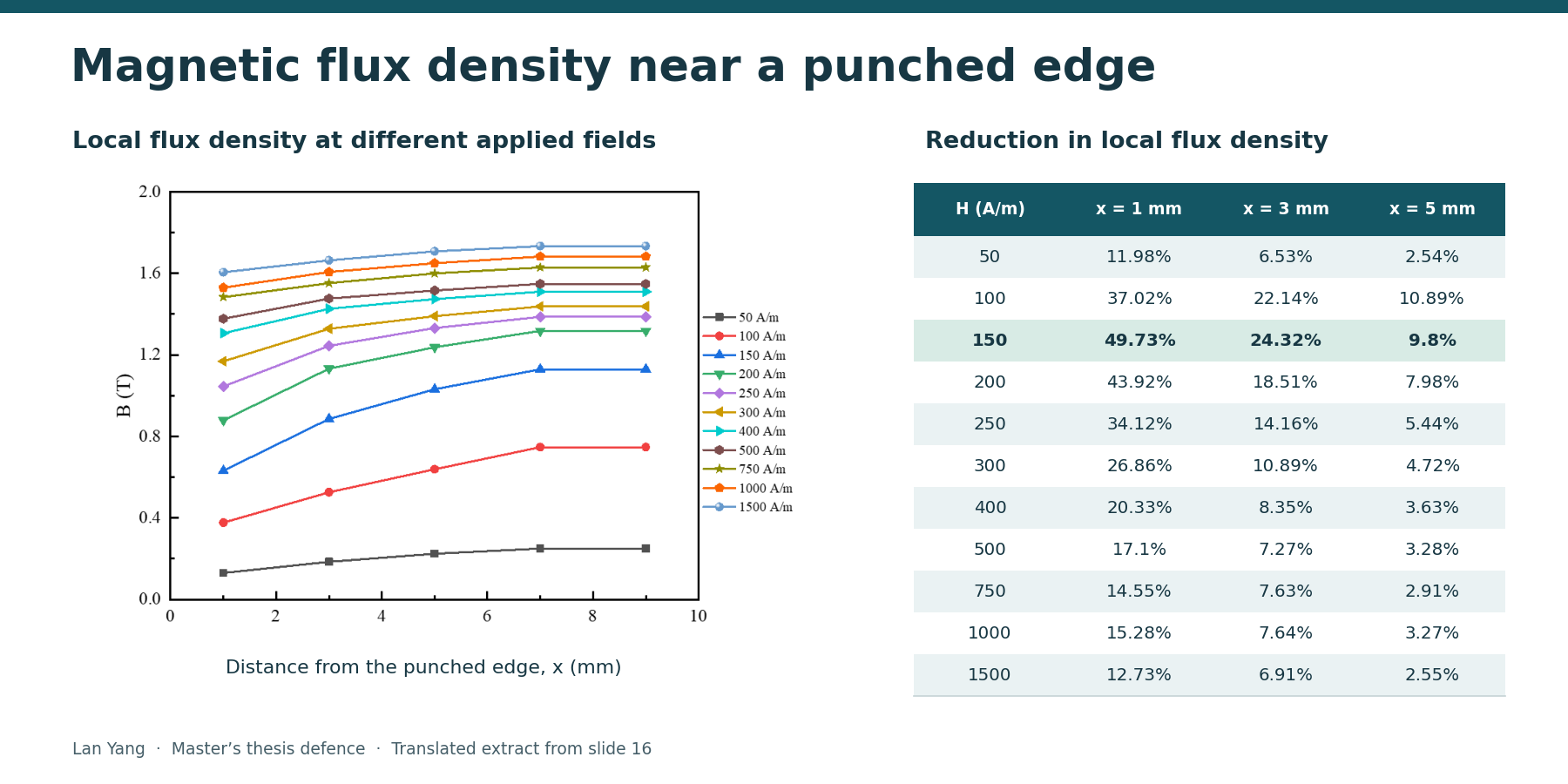
Yang combined a miniature field coil and a flux-density probe in a movable sensor. She measured field strength and flux density at successive distances from the punched edge of a B35A270 non-oriented electrical steel specimen. She also used magneto-optical Kerr microscopy to observe magnetic domains near the edge and incorporated the measured changes in material properties into a finite-element model of a permanent-magnet synchronous motor.
In the steel she tested, magnetic degradation extended about 7 mm inward and was greatest within the first 1 mm. At an applied field of 150 A/m, local flux density fell by 49.73% at 1 mm from the edge, 24.32% at 3 mm and 9.8% at 5 mm. Read the related paper on magnetic properties near punched edges.