Simplified Calculation Model for Contact Resistance Based on Fractal Rough Surfaces Method
-
date_range 13/03/2023 00:00 infosortPaperslabelBaichuan Yu
Authors Changgeng Zhang, Baichuan Yu, Yongjian Li, Qingxin Yang
Journal Applied Sciences 13(6), 3648 (2023)
First published online 13 March 2023
DOI 10.3390/app13063648
Download full paper (PDF) · 15 pages · 7.4 MB
Download full paper with cover (PDF) · 16 pages · 2.2 MB
Research brief
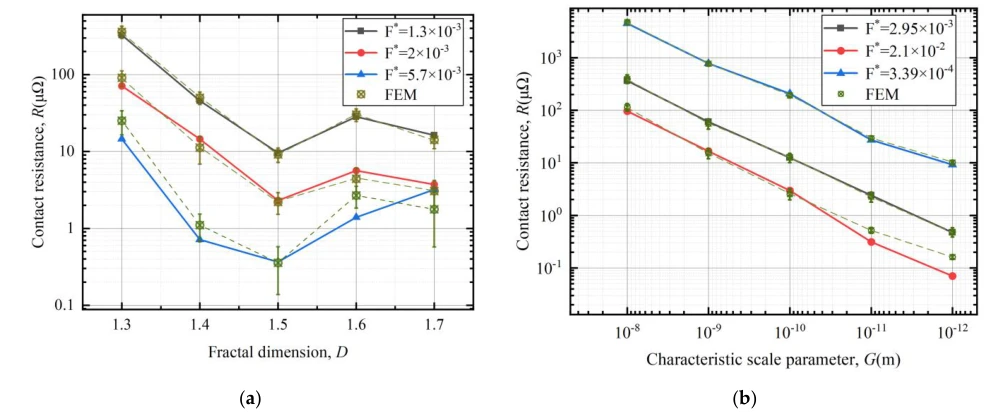
The apparent contact area of two conductors hides the small patches that actually carry current. A statistical model links those patches and a surface film to contact resistance. Among the surfaces studied at a given load, a fractal dimension of 1.5 gave the lowest resistance.
Abstract
Electrical contact resistance (ECR) is critical to evaluate the stability and reliability of electrical connections. In this paper, a simplified contact model is established for rough surfaces based on the fractal theory and Monte Carlo method, which can overcome the difficulty of constructing the resistance networks for traditional contact models. The model reveals the influence of fractal parameters D and G on the surface morphology and contact characteristics. The established surface method can simulate Gaussian and non-Gaussian isotropic surfaces. Then the contact resistance considering a contaminated film is calculated, which provides a quantitative analysis of the change and the influencing factors. The accuracy of the calculation method in this paper is ensured by comparing the existing experimental data and finite element results. The results show that the contact surface with D of 1.5 has the largest real contact area and the smallest contact resistance. The model has accurate calculation results when dimensionless contact load F* is less than 4 × 10⁻³.
Keywords Fractals, rough surfaces, contact characteristics, contact resistance