
Changgeng Zhang’s students Min Zhang and Haoran Li successfully defend their master’s theses
-
date_range 24/05/2023 infosort Graduations labeldefence
On 24 May 2023, Min Zhang and Haoran Li successfully defended their master’s theses at the School of Electrical Engineering, Hebei University of Technology. Both were supervised by Associate Professor Changgeng Zhang. Min studied how electrical pulses affect loss in a nanocrystalline magnetic core. Haoran measured how the magnetic response of ultra-thin electrical steel changes as the steel heats up.
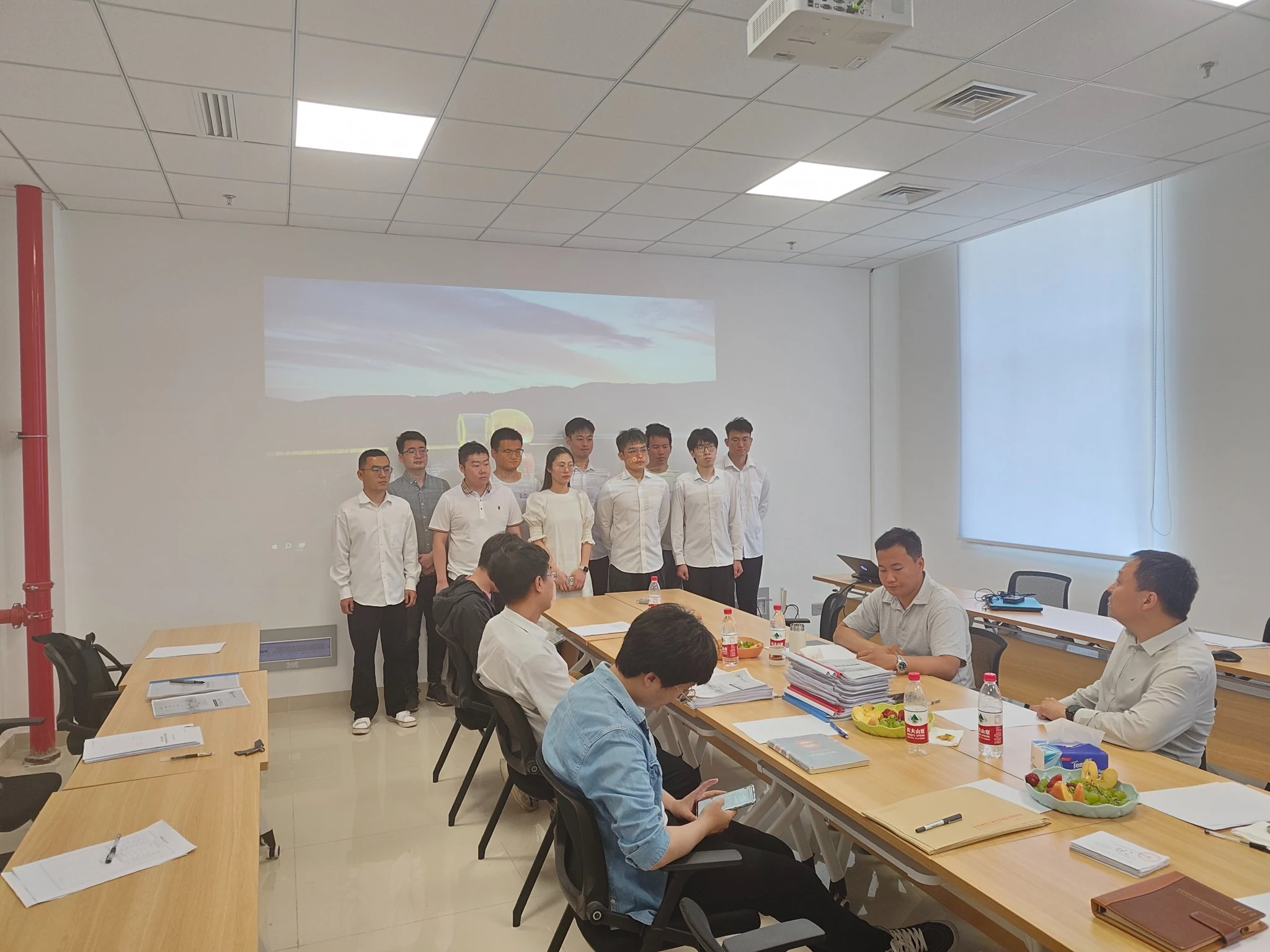
Min Zhang measures loss in a nanocrystalline core under pulsed excitation
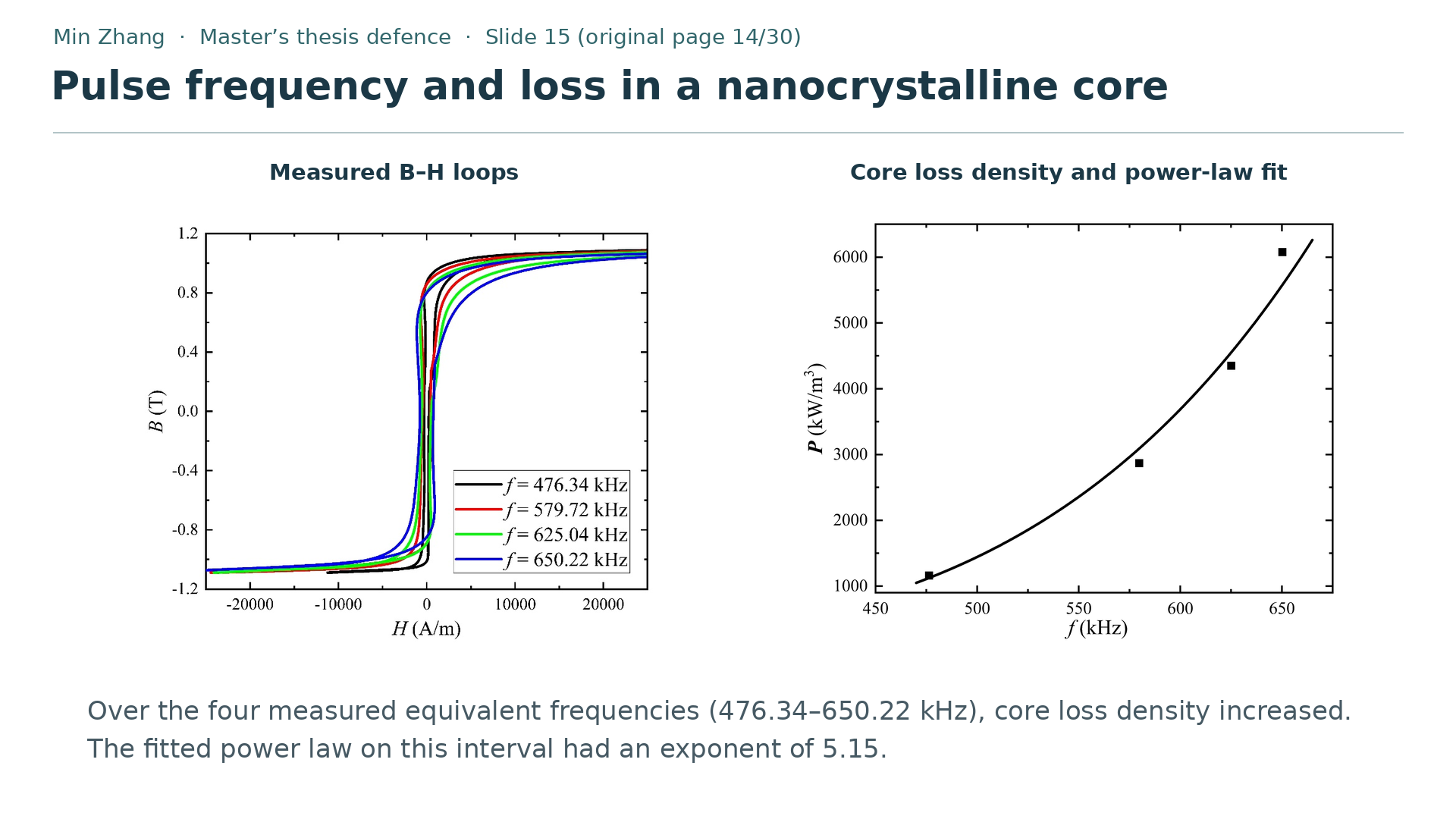
For his thesis, Measurement and Simulation of the Magnetic Properties of Nanocrystalline Soft Magnetic Materials under Pulsed Excitation, Min used two windings to measure hysteresis loops under different pulse waveforms. He calculated core loss from the area enclosed by each loop. At four equivalent pulse frequencies ranging from 476.34 to 650.22 kHz, loss per unit volume increased with equivalent frequency. A power-law fit to those four measurements gave an exponent of 5.15.
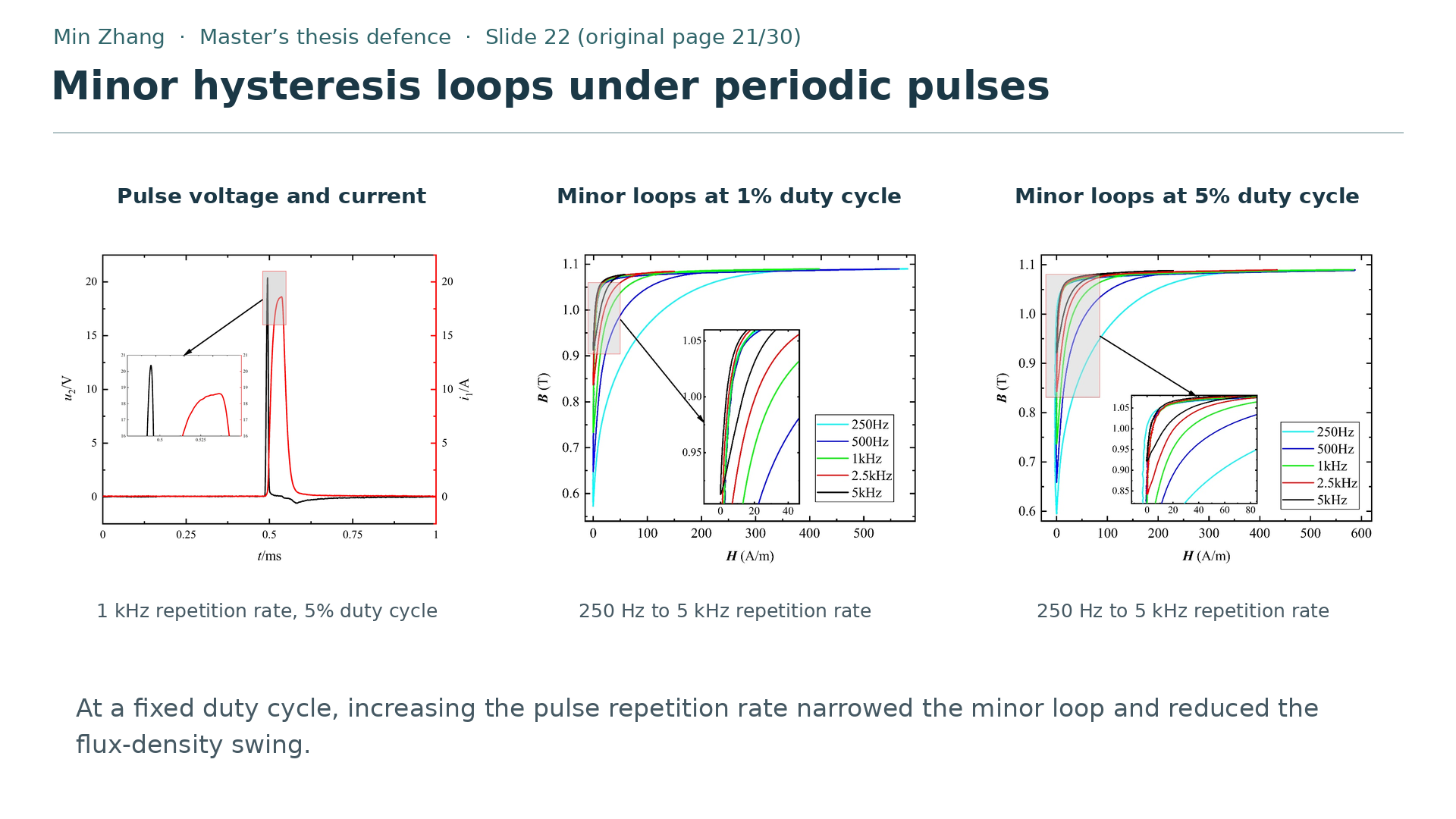
In a separate experiment, Min varied how often the pulses repeated. He increased the repetition rate from 250 Hz to 5 kHz, in separate tests at duty cycles of 1% and 5%. In both cases the flux density swung through a smaller range during each cycle, and the minor hysteresis loops narrowed. He also simulated the magnetisation process with a coupled field–circuit model. The descending branch of the simulated loop was flatter than the measured one.
Haoran Li tests ultra-thin electrical steel at five temperatures
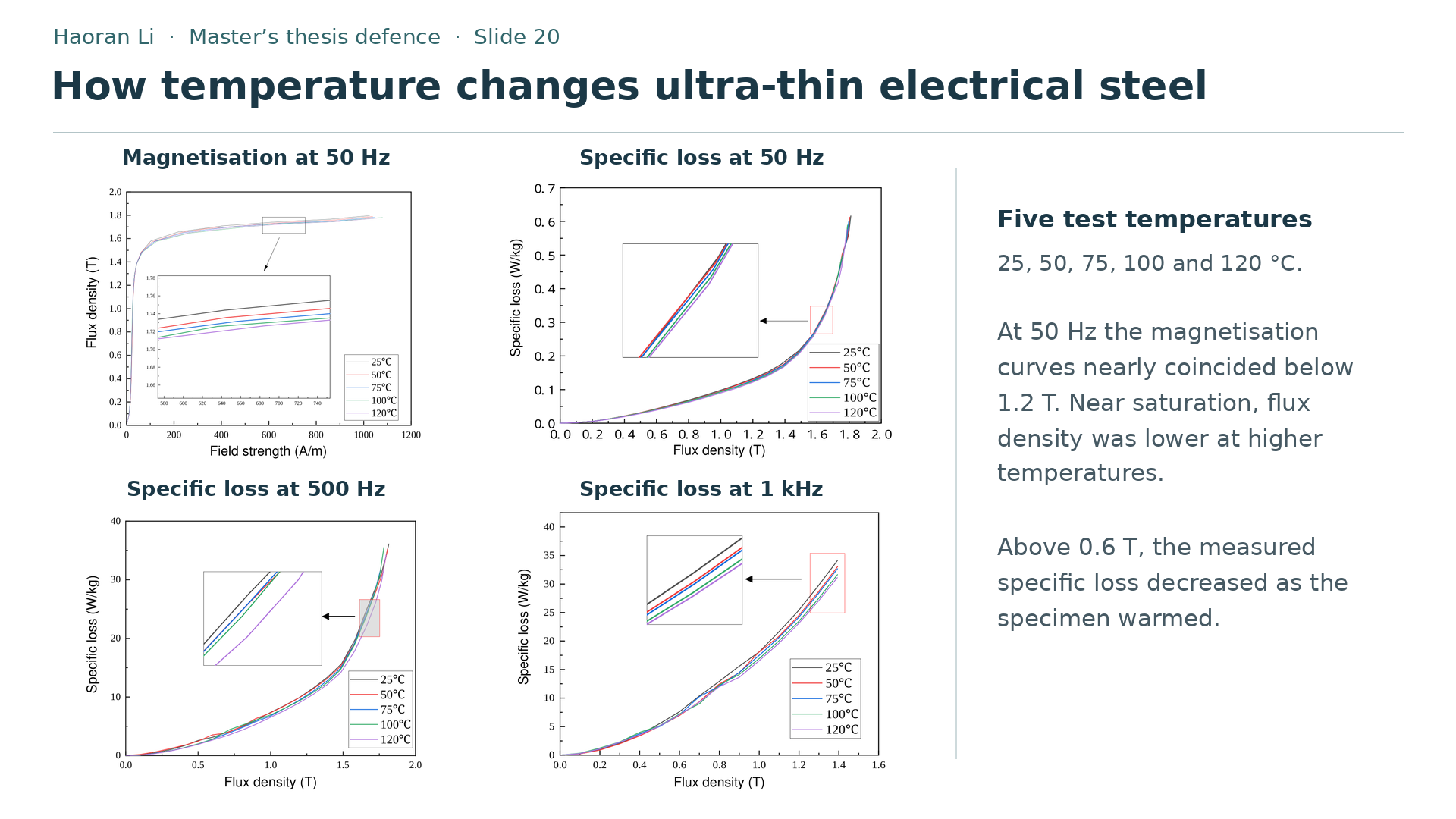
For his thesis, Measurement and Simulation of Hysteresis in Ultra-Thin Electrical Steel at Different Temperatures, Haoran placed an Epstein frame in a temperature chamber and measured magnetisation curves and core loss on the same specimen at 25, 50, 75, 100 and 120 °C. At 50 Hz, the five magnetisation curves nearly coincided below 1.2 T. They diverged as the steel approached saturation. At the same field strength, the hotter steel reached a lower flux density. The 50 Hz loss curves also showed that above 0.6 T, the warmer specimen dissipated less power at a given flux density.
Haoran incorporated a static Jiles–Atherton hysteresis model into a ladder equivalent circuit and tested its predictions against dynamic hysteresis loops measured at 50 and 120 °C. At 500 Hz and 1 kHz the simulation followed the measured loops closely up to 1.2 T. Above that range, the discrepancy grew near the knee of the loop as the steel approached saturation.