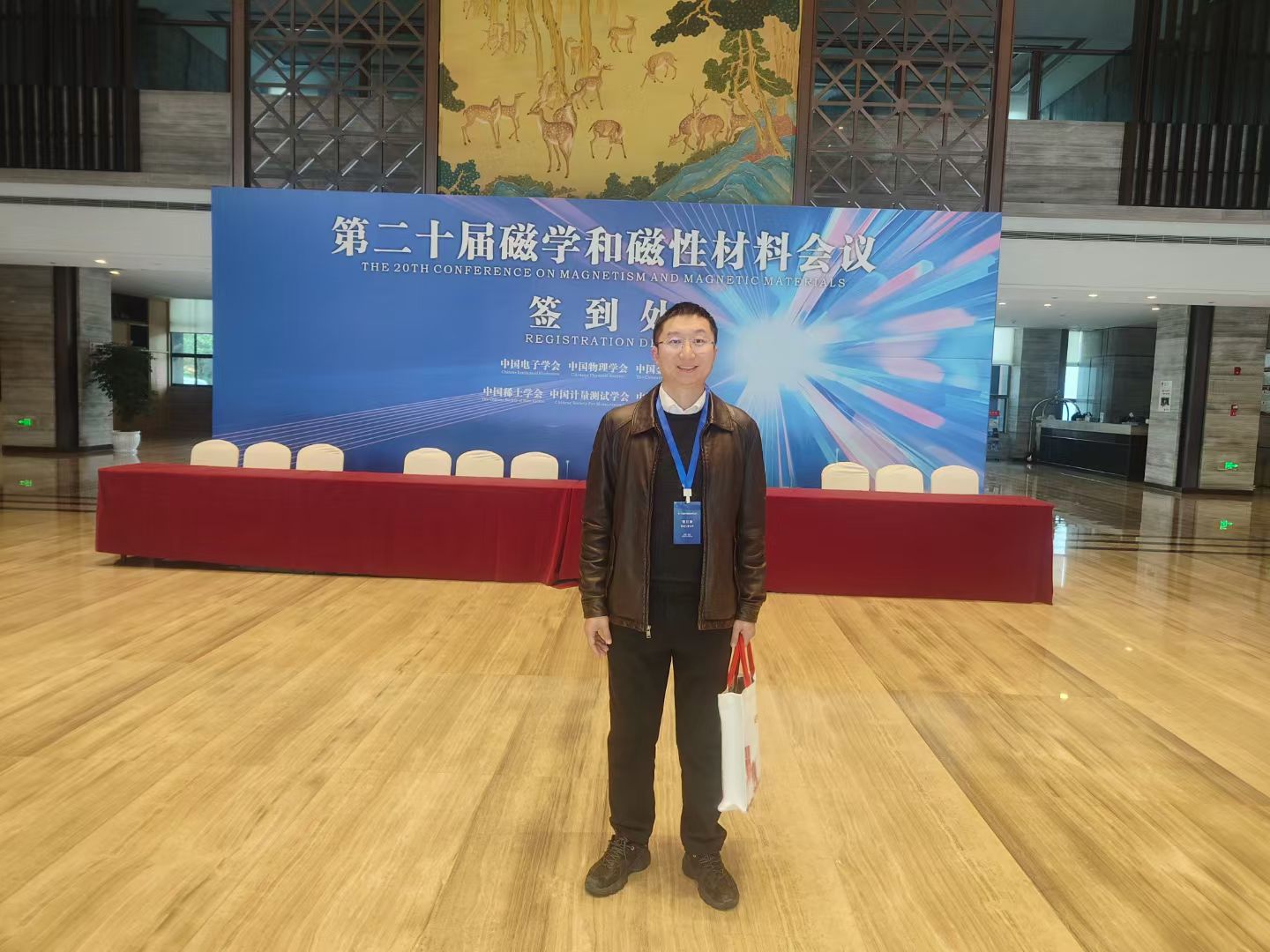
Prof. Changgeng Zhang presents research on reducing high-frequency loss in iron–silicon powder cores at the Zunyi magnetism conference
-
date_range 11/11/2025 info
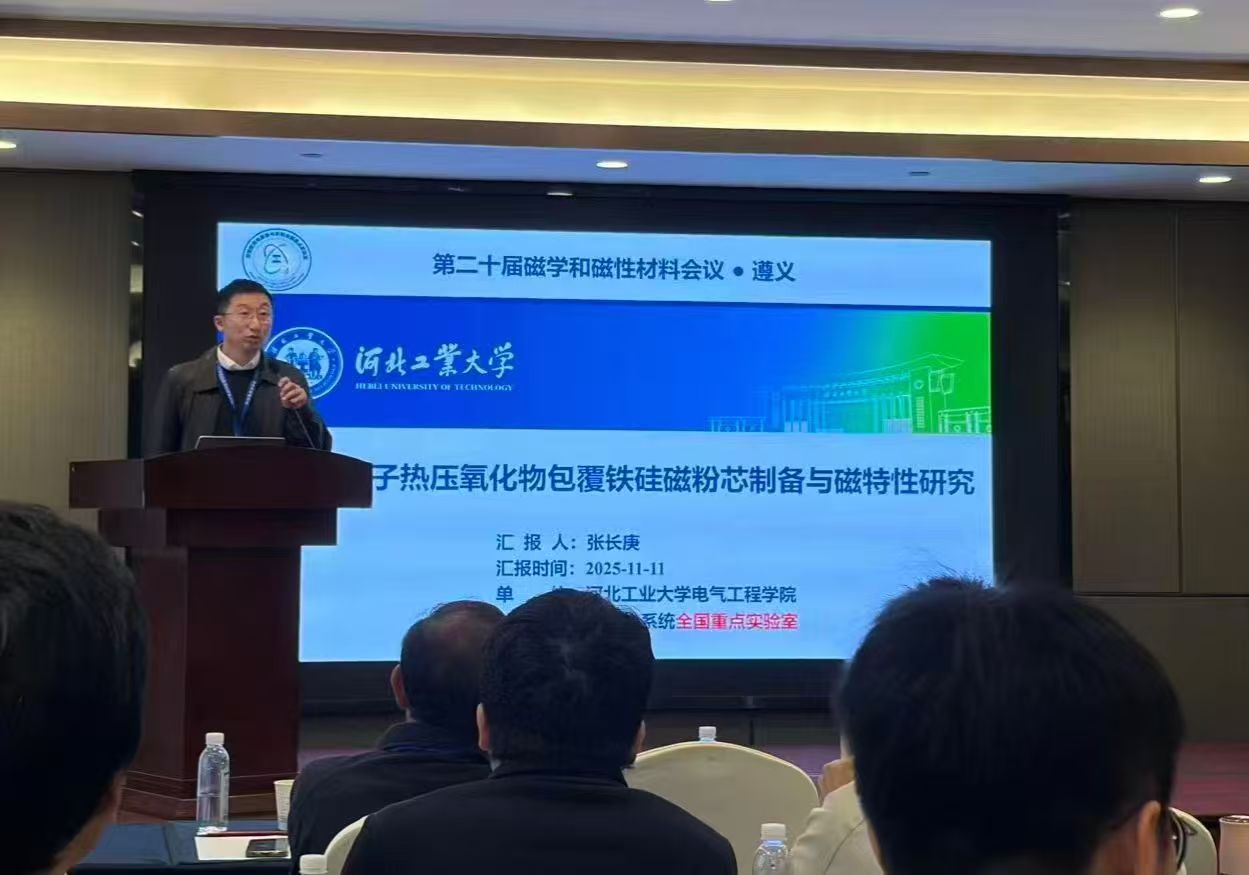
On 11 November 2025, Prof. Changgeng Zhang of Hebei University of Technology presented Preparation and Magnetic Properties of Oxide-Coated Iron–Silicon Powder Cores Produced by Spark Plasma Sintering at the 20th Conference on Magnetism and Magnetic Materials in Zunyi, Guizhou, China. Using electron micrographs of the powder and measurements on finished cores, he examined a practical question for high-frequency components. How much loss can an insulating layer between iron–silicon particles prevent, and what happens to permeability as the coating gets thicker?
From a coating on the powder to insulation in the core
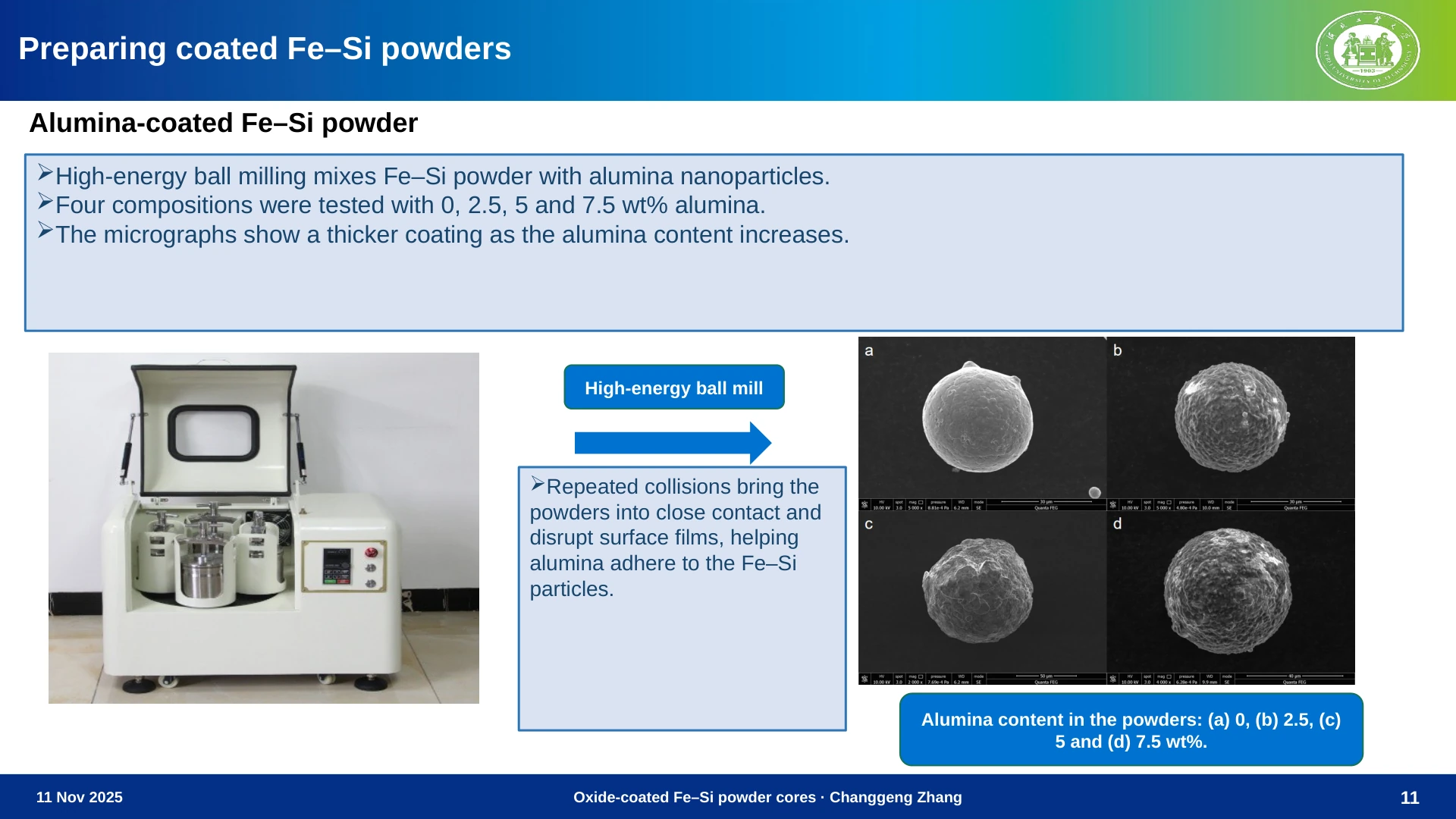
The team used high-energy ball milling to mix iron–silicon powder with alumina nanoparticles. They prepared four batches containing 0, 2.5, 5 and 7.5 wt% alumina and consolidated each into toroidal cores by spark plasma sintering. Scanning electron micrographs showed that the coating on the iron–silicon particles grew thicker as the alumina content increased.
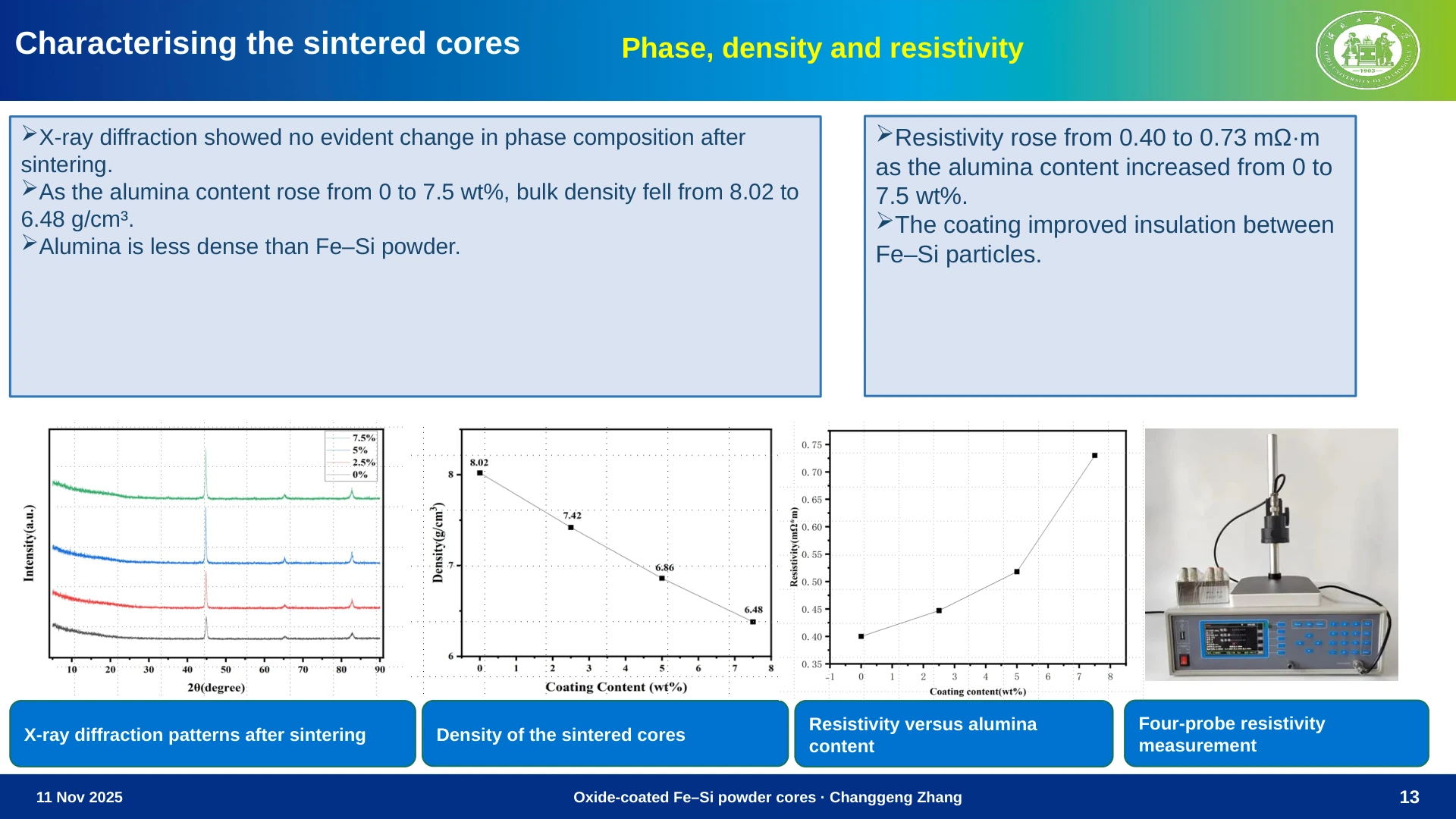
Zhang then showed how that change at the particle surface affected the sintered cores. In four-probe measurements, resistivity rose from 0.40 mΩ·m for the uncoated core to 0.73 mΩ·m for the core containing 7.5 wt% alumina. Higher electrical resistance between particles restricts the paths available to eddy currents in an alternating magnetic field.
Comparing core losses under the same excitation
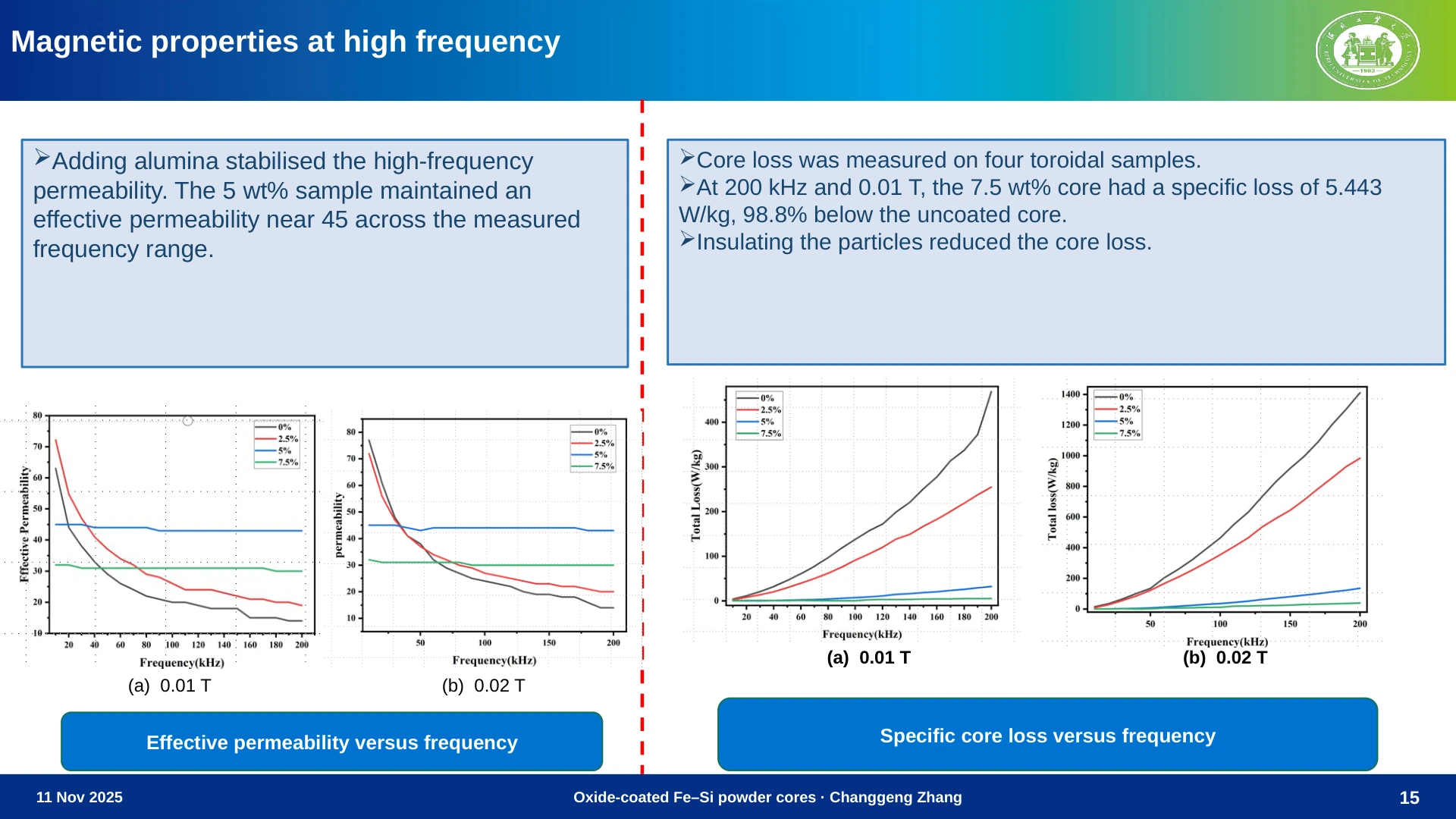
At 200 kHz and 10 mT (0.01 T), the core containing 7.5 wt% alumina had a total specific core loss of 5.443 W/kg, 98.8% lower than the uncoated core under the same conditions. The permeability curves gave a second guide to composition. The 5 wt% core maintained an effective permeability of about 45 across the measured frequency range. For a component operating at a given frequency, the two sets of curves help designers assess both heat generated in the core and the permeability the application requires.
About the conference
The Conference on Magnetism and Magnetic Materials is a biennial national meeting in China. Six scientific societies, including the Chinese Institute of Electronics and the Chinese Physical Society, jointly organised the 20th edition, held in Zunyi on 9–12 November 2025. More than 280 delegates attended from over 80 universities, research institutes and companies. The meeting received 169 abstracts across 14 fields. Five venues hosted talks on subjects ranging from fundamental magnetism to permanent and soft magnets, high-frequency magnetic properties and magnetic measurement. Conference report from the Chinese Institute of Electronics (in Chinese)