Angle-compensated non-invasive current measurement of multi-conductor cables via a TMR sensor-array
-
date_range 18/02/2026 00:00 info
Authors Fugui Liu, Shuai Zhao, Shuokao Mu, Yongjian Li, Changgeng Zhang
Journal AIP Advances 16(2), 025237 (2026)
First published online 18 February 2026
DOI 10.1063/9.0000987
Download full paper (PDF) · 6 pages · 5.8 MB
Research brief
A ring of magnetic sensors separates the contributions of three conductors to the field measured outside a cable.
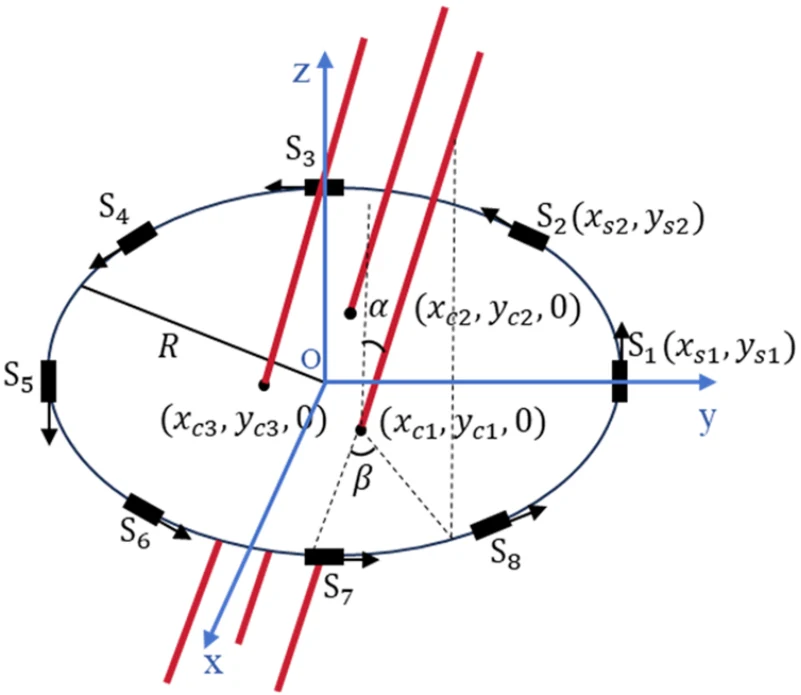
Eight tunneling magnetoresistance (TMR) sensors sampled the field around a three-conductor cable. A two-stage optimization estimated conductor positions and tilt angles before reconstructing the phase currents. The maximum relative error stayed below 7% across the balanced three-phase tests. For one fixed conductor arrangement, tilt compensation reduced the fundamental current amplitude error from 6.03% to 1.2%.
Abstract
Real-time current monitoring of currents in smart grid poses significant challenges, particularly within multi-conductor cables where inherent phase imbalance and complex electromagnetic coupling distort the magnetic field patterns, complicating accurate measurement. Conventional non-invasive techniques are often applied to a single conductor, insufficient adaptability to multiple varying conductor arrangements, and require operational interruption for installation. To address these issues, this study designs an angle-compensated non-invasive current measurement method for multi-conductor cables with an annular TMR sensor array. A current inversion model incorporating conductor position and inclination parameters is established. A dual-stage optimization strategy combining Particle Swarm Optimization and the Levenberg–Marquardt Algorithm is proposed to solve the inversion problem efficiently. Experimental results demonstrate that the maximum current error remains below 7% under balanced three-phase conditions. The method also maintains high accuracy in the presence of conductor eccentricity, enabling reliable non-invasive current measurement across diverse multi-conductor configurations.