Three international students in Prof. Changgeng Zhang’s group present research on soft magnetic materials
-
date_range 29/05/2026 info
On 29 May 2026, three international graduate students supervised by Prof. Changgeng Zhang presented their work in Room B324 at the School of Electrical Engineering, Hebei University of Technology. The school’s Department of New Electrical Technologies held the session from 3 to 5 p.m. The students gave a doctoral progress report, a doctoral literature review and a master’s thesis proposal.
Rawal Shahbaz reports on laser-cut electrical steel
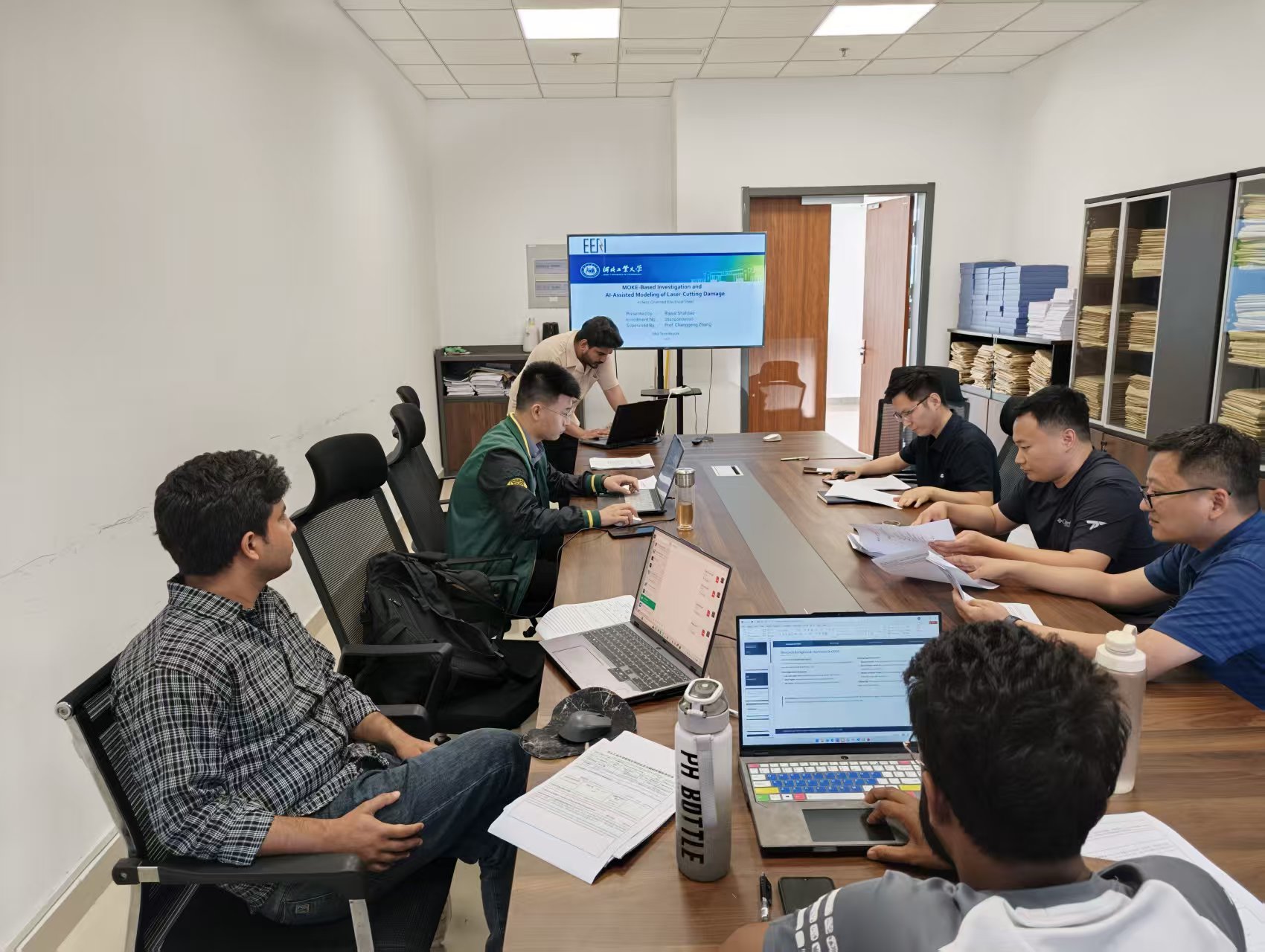
How far into a sheet of electrical steel does damage from a laser cut extend? Rawal Shahbaz addressed this question in his doctoral progress report, MOKE-Based Investigation and AI-Assisted Modeling of Laser-Cutting Damage in Non-Oriented Electrical Steel. He uses the magneto-optical Kerr effect (MOKE) to observe magnetic domains and compare how the steel magnetises near the cut edge and farther inside the sheet. He also discussed how AI-assisted modelling can describe these local changes in magnetic behaviour.
Raja Saqib Arshad reviews ways to reduce core loss
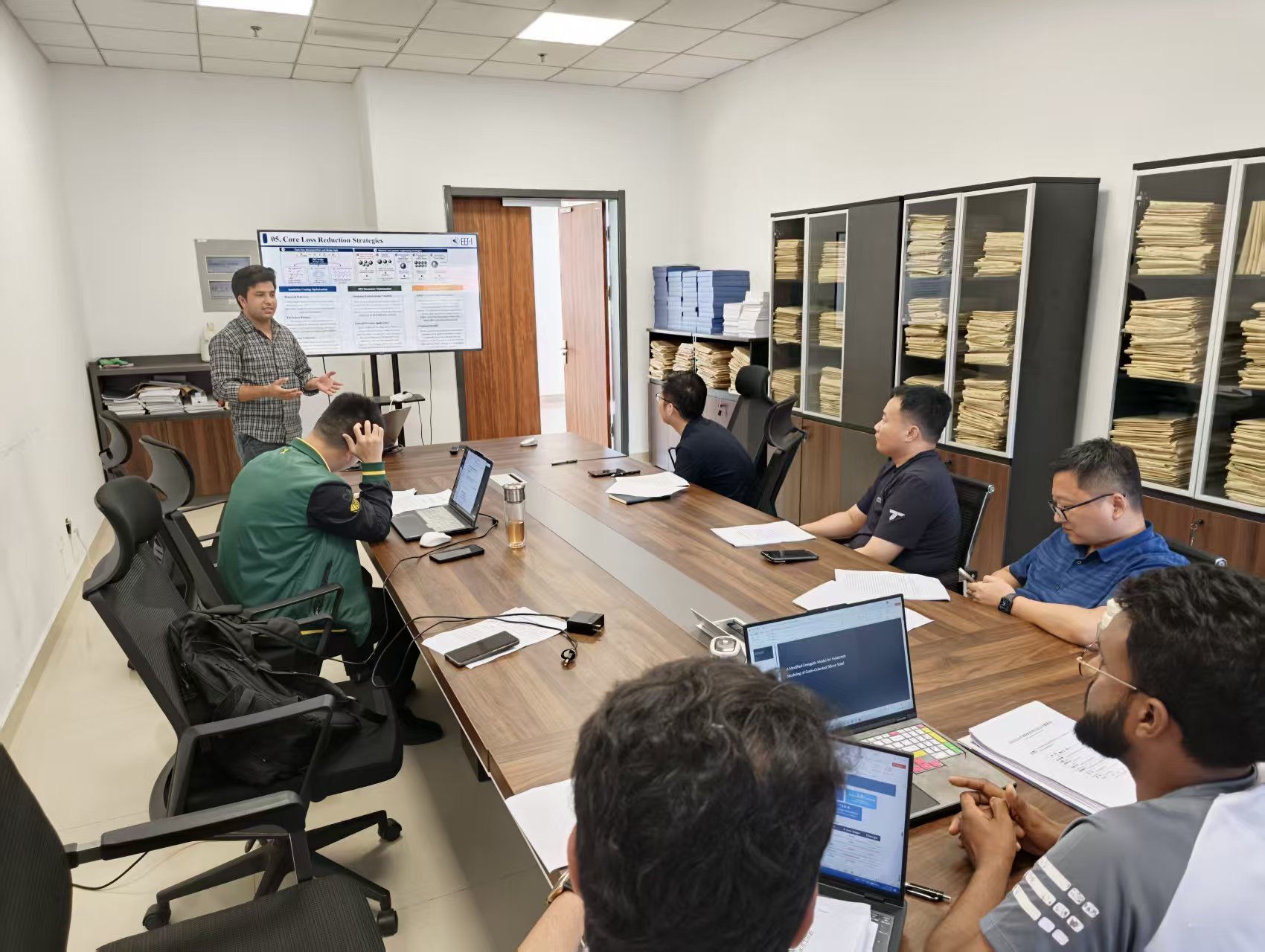
Raja Saqib Arshad’s doctoral literature review, A low-loss and high-frequency soft composite magnetic material prepared by SPS, examined ways to reduce losses in magnetic cores at high frequencies. He discussed two related choices in processing the material. Insulating coatings on the magnetic powder restrict eddy currents between particles. The conditions used in spark plasma sintering (SPS) influence how well that insulation survives as the powder is consolidated into a core.
Sujun Babu proposes a hysteresis model for grain-oriented silicon steel
Sujun Babu presented his master’s thesis proposal, A Modified Energetic Model for Hysteresis Modeling of Grain-Oriented Silicon Steel. As the applied field rises and falls, a steel sheet can reach different states of magnetisation at the same field strength. He proposed modifying an energy-based model to describe the hysteresis loops that form as grain-oriented silicon steel is magnetised over successive cycles.
Prof. Ling Weng chaired the panel, with Kun Wang and Bin Yang as members. Shuaichao Yue served as secretary.