An integrated approach for magnetostriction measurement and simulation of nanocrystalline alloys in high-frequency transformers
-
date_range 11/06/2026 00:00 info
Authors Xiaotong Wang, Changgeng Zhang, Yongjian Li, Hao Zhang, Qingxin Yang
Journal IEICE Electronics Express 23(13), 20260119 (2026)
First published online 11 June 2026
DOI 10.1587/elex.23.20260119
Download full paper (PDF) · 6 pages · 1.8 MB
Research brief
A double-yoke fixture and laser vibrometer resolve the small cyclic strains that contribute to vibration in high-frequency transformer cores.
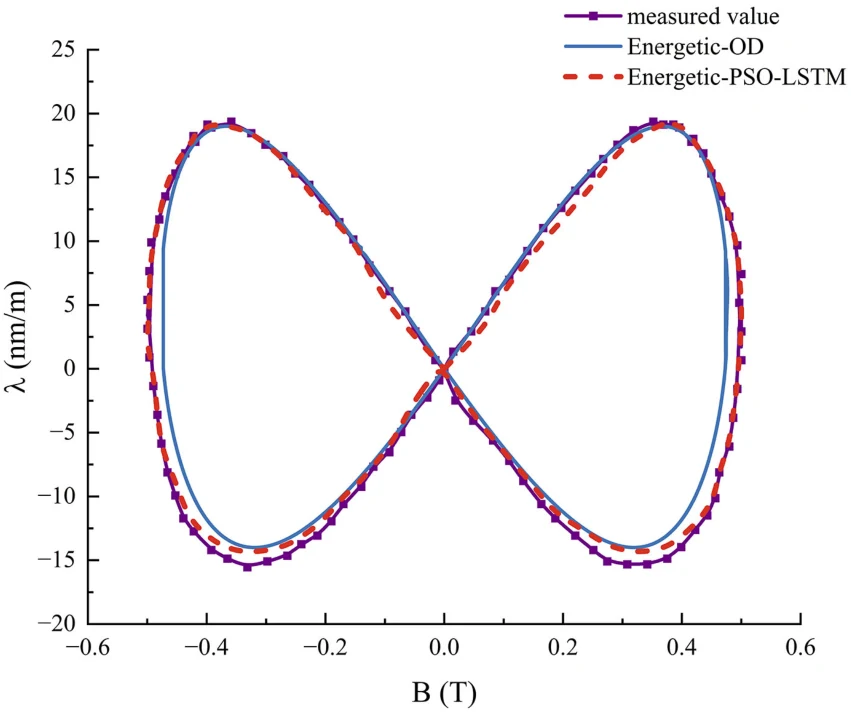
We measured dynamic magnetostriction in 1K107B nanocrystalline laminations using symmetric magnetic yokes and a mirror that folds the laser beam into an L-shaped path. An energy-based model predicts the strain, and a particle-swarm-optimized LSTM corrects its residual error. Under sinusoidal excitation at 5 kHz and 0.5 T, this correction reduced root-mean-square error by 49.64% relative to the energy-based model alone.
Abstract
Accurately predicting the magnetostriction of nanocrystalline alloy laminations is crucial for analyzing high-frequency transformer core vibration and noise. To resolve the magnetic circuit asymmetry in existing single-yoke measurements, a high-frequency magnetostriction testing system for nanocrystalline laminations is designed with a double-yoke configuration, adopting a mirror-reflected L-shaped laser path to achieve precise measurement under high-frequency sinusoidal excitation. To overcome the limitations of traditional simulation models relying on single physical mechanisms or pure data-driven approaches, a universal dynamic magnetostriction simulation method based on the Energetic-PSO-LSTM coupled model is proposed. Comparative verification shows that at 0.5 T, the coupled model’s RMSE is reduced to 0.69, significantly improving prediction accuracy and validating its reliability.
Keywords Dynamic magnetostriction properties, Energetic-PSO-LSTM coupled model, nanocrystalline alloy